Advertisements
Advertisements
प्रश्न
Explain the rules for obtaining images formed by a convex lens with the help of ray diagram.
Advertisements
उत्तर
- Rule 1: When a ray of light strikes the convex or concave lens obliquely at its optical centre, it continues to follow its path without any deviation.

Rays passing through the optical centre - Rule-2: When rays parallel to the principal axis strikes a convex or concave lens, the refracted rays are converged to (convex lens) or appear to diverge from (concave lens) the principal focus

Rays passing parallel to the optic axis - Rule-3: When a ray passing through (convex lens) or directed towards (concave lens) the principal focus strikes a convex or concave lens, the refracted ray will be parallel to the principal axis
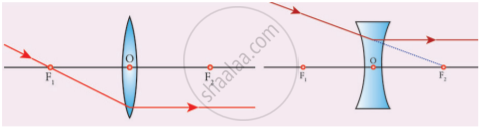
Rays passing through or directed towards the principal focus
APPEARS IN
संबंधित प्रश्न
A lens forms an upright and diminished image of an object when the object is placed at its focal point. Name the lens and draw a ray diagram to show the image formation.
A lens forms an erect, magnified, and virtual image of an object. Draw a labelled ray diagram to show the image formation.
A lens forms an inverted image of an object. What is the nature of the image real or virtual?
An object is placed at a distance of more than 40 cm from a convex lens of focal length 20 cm. The image formed is real, inverted and ______.
An object is placed at a distance 2f from a convex lens of focal length f. The size of the image formed is ______ that of the object.
An object is placed at a distance 5 cm from a convex lens of focal length 10 cm. The image formed is virtual, upright and _____.
A small bulb is placed at the principal focus of a convex lens. When the bulb is switched on, the lens will produce
An object is placed at a distance 20cm from a convex lens of focal length 10cm. Find the image distance and nature of the image.
A student focussed the image of a candle flame on a white screen using a convex lens. He noted down the position of the candle screen and the lens as under
Position of candle = 12.0 cm
Position of convex lens = 50.0 cm
Position of the screen = 88.0 cm
- What is the focal length of the convex lens?
- Where will the image be formed if he shifts the candle towards the lens at a position of 31.0 cm?
- What will be the nature of the image formed if he further shifts the candle towards the lens?
- Draw a ray diagram to show the formation of the image in case (iii) as said above.
A lens forms an upright and magnified image of an object. Draw a labelled ray diagram to show the image formation.
