Advertisements
Advertisements
प्रश्न
A lens forms an erect, magnified, and virtual image of an object. Draw a labelled ray diagram to show the image formation.
Advertisements
उत्तर
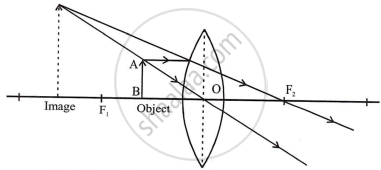
APPEARS IN
संबंधित प्रश्न
A converging lens forms the image of an object placed in front of it beyond 2F2 of the lens. Where is the object placed?
Draw a ray diagram to show how a converging lens can form a real and enlarged image of an object.
Draw a ray diagram to show how a converging lens can form an image of the sun. Hence give a reason for the term ‘burning glass’ for a converging lens used in this manner.
A lens forms an inverted image of an object. What is the nature of the image real or virtual?
For the object placed between the optical centre and focus of a convex lens, the image is ______.
A small bulb is placed at the principal focus of a convex lens. When the bulb is switched on, the lens will produce
Which of the following lens would you prefer to use while reading small letters found in a dictionary?
Explain the rules for obtaining images formed by a convex lens with the help of ray diagram.
An object of height 3cm is placed at 10cm from a concave lens of focal length 15cm. Find the size of the image.
Sudha finds out that the sharp image of the window pane of her science laboratory is formed at a distance of 15 cm from the lens. She now tries to focus the building visible to her outside the window instead of the window pane without disturbing the lens. In which direction will she move the screen to obtain a sharp image of the building? What is the approximate focal length of this lens?
