Advertisements
Advertisements
प्रश्न
Define the power of a lens.
Define the term power of a lens.
Advertisements
उत्तर १
Power of a lens is defined as the ability of a lens to bend the rays of light. It is given by the reciprocal of focal length in metre.
उत्तर २
The power of a lens is a measure of the deviation produced by it in the path of rays refracted through it.
APPEARS IN
संबंधित प्रश्न
What is meant by a power of a lens? Define its SI unit.
What is the focal length of a convex lens of focal length 30 cm in contact with a concave lens of focal length 20 cm? Is the system a converging or a diverging lens? Ignore thickness of the lenses.
(a) At what distance should the lens be held from the figure in order to view the squares distinctly with the maximum possible magnifying power?
(b) What is the magnification in this case?
(c) Is the magnification equal to the magnifying power in this case? Explain.
A converging lens has focal length of 50 mm. What is the power of the lens?
What is the power of a convex lens lens whose focal length is 80 cm?
A doctor has prescribed a corrective lens of power, −1.5 D. Find the focal length of the lens. Is the prescribed lens diverging or converging?
The focal length of a lens is +150 mm. What kind of lens is it and what is its power?
On reducing the focal length of a lens, its power ______.
A normal eye is not able to see objects closer than 25 cm because
A double convex lens has two surfaces of equal radii R and refractive index \[m = 1 \cdot 5\]
Surabhi from std. X uses spectacle. The power of the lenses in her spectacle is 0.5 D.
Answer the following questions from the given information:
- Identify the type of lenses used in her spectacle.
- Identify the defect of vision Surabhi is suffering from.
- Find the focal length of the lenses used in her spectacle.
How is accommodation produced?
Find the power of a convex lens of focal length of + 25 cm.
According to Rayleigh’s scattering law, the amount of scattering of light is inversely proportional to the fourth power of its ______.
Assertion and reasoning type
- Assertion: Myopia is due to the increase in the converging power of eye lens.
- Reason: Myopia can be corrected with the help of concave lens.
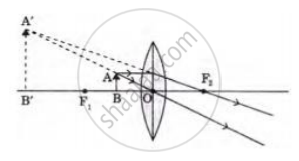
The above lens has a focal length of 10 cm. The object of height 2 mm is placed at a distance of 5 cm from the pole. Find the height of the image.
The lens of power + 1·0 D is ______.
The power of a lens in dioptres is given by:
A negative power of a lens indicates a:
