Advertisements
Advertisements
प्रश्न
A converging lens has focal length of 50 mm. What is the power of the lens?
Advertisements
उत्तर
Power of a lens is given by:
Power (P) `=1/f`
∴`p=1/(50xx10^-3)=1000/50=20.D`
संबंधित प्रश्न
State the power of a lens S.I. unit.
A convex lens forms a real and inverted image of a needle at a distance of 50 cm from it. Where is the needle placed in front of the convex lens if the image is equal to the size of the object? Also, find the power of the lens.
Consider two statements A and B given below:
A: real image is always inverted
B: virtual image is always erect
Out of these two statements:
Name the physical quantity whose unit is dioptre.
How is the power of a lens related to its focal length?
What is the nature of a lens whose power is, −4 D?
A convex lens of power 5 D and a concave lens of power 7.5 D are placed in contact with each other. What is the :
(a) power of this combination of lenses?
(b) focal length of this combination of lenses?
What do you understand by the power of a lens?
What is the unit of power of a lens? Define the unit of power of a lens.
A converging lens has a focal length of 50 cm. The power of this lens is:
How is the power of a lens related to its focal length?
Define power of a lens. Write its units. Deduce the relation `1/f =1/f_1 +1/f_2`for two thin lenses kept in contact coaxially.
Consider three converging lenses L1, L2 and L3 having identical geometrical construction. The index of refraction of L1 and L2 are \[\mu_1 \text{ and } \mu_2\] respectively. The upper half of the lens L3 has a refractive index \[\mu_1\] and the lower half has \[\mu_2\] following figure . A point object O is imaged at O1 by the lens L1 and at O2 by the lens L2placed in same position. If L3 is placed at the same place,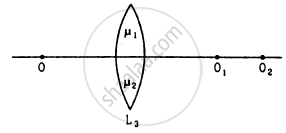
(a) there will be an image at O1
(b) there will be an image at O2.
(c) the only image will form somewhere between O1 and O2
(d) the only image will form away from O2.
Which lens has more power a thick lens or a thin lens?
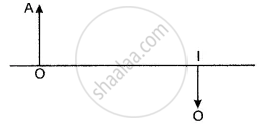
The following diagram shows the object O and the image I formed by a lens. Copy the diagram and on it mark the positions of the lens LL’ and focus (F). Name the lens.
Complete the diagram to show the formation of the image of the object AB.
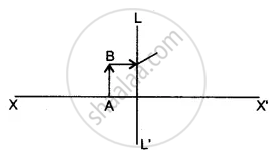
(i) Name the Lens LL’.
(ii) Where is the image of the object AB formed?
(iii) State three characteristics of the image.
The power of the magnifying glass depends on the distance of the magnifying glass from object.
Define power of a lens. What is its unit? One student uses a lens of focal length 50 cm and another of –50 cm. What is the nature of the lens and its power used by each of them?
A point object is placed at O in front of a glass sphere as shown in figure.

Show the formation of the image by the sphere.
When monochromatic red light is used instead of blue light in a convex lens, its focal length will ______.
The power of convex lens of focal length 20 cm is ______.
The focal length of a double convex lens is equal to the radius of curvature of either surface. What is the refractive index of its material?
The power of a lens is defined as the:
1 D is equivalent to:
A convex lens is a converging lens whose focal length and power are both:
A positive power of a lens indicates a:
A convex lens has:
The power of a lens of focal length \[f = 0.5\,m\] is:
