Advertisements
Advertisements
प्रश्न
A convex lens forms a real and inverted image of a needle at a distance of 50 cm from it. Where is the needle placed in front of the convex lens if the image is equal to the size of the object? Also, find the power of the lens.
Advertisements
उत्तर
Since the image is real and same size. The position of image should be at 2F.
It is given that the image of the needle is formed at a distance of 50 cm from the convex lens. Hence, the needle is placed in front of the lens at a distance of 50 cm.
Object distance, u = – 50 cm
Image distance, v = 50 cm
Focal length = f
According to the lens formula,
`1/v-1/u = 1/f`
`1/f = 1/50 - 1/(-50)`
`=1/50 + 1/50 = 1/25`
f = 25 cm
Power of lens, `p = 100/f ("cm")D`
= `100/25D`
= 4D
APPEARS IN
संबंधित प्रश्न
Calculate the focal length of a corrective lens having power +2.5 D.
Define the power of a lens.
What does sign of power (+ve or –ve) indicate?
State the power of a lens S.I. unit.
How unit of power related to focal length of a lens?
(a) At what distance should the lens be held from the figure in order to view the squares distinctly with the maximum possible magnifying power?
(b) What is the magnification in this case?
(c) Is the magnification equal to the magnifying power in this case? Explain.
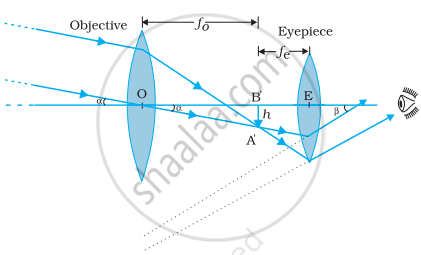
Consider two statements A and B given below:
A: real image is always inverted
B: virtual image is always erect
Out of these two statements:
An object of height 4.25 mm is placed at a distance of 10 cm from a convex lens of power +5D. Find (i) the focal length of the lens, and (ii) the size of the image.
A combination of lenses for a camera contains two converging lenses of focal lengths 20 cm and 40 cm and a diverging lens of focal length 50 cm. Find the power and focal length of the combination.
The power of a lens is + 1.0 D is :
How does focal length of a lens change when red light incident on it is replaced by violet light? Give reason for your answer.
Mohan obtained a sharp inverted image of a distant tree on the screen placed behind the lens. He then moved the screen and tried to look through the lens in the direction of the object. He would see:
(1) a blurred image on the wall of the laboratory.
(2) an erect image of the tree on the lens.
(3) no image as the screen has been removed
(4) an inverted image of the tree at the focus of the lens.
Find the radius of curvature of the convex surface of a plano-convex lens, whose focal length is 0.3 m and the refractive index of the material of the lens is 1.5.
The power of the magnifying glass depends on the distance of the magnifying glass from object.
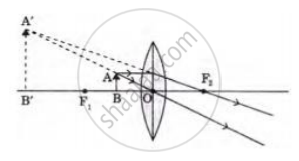
The above lens has a focal length of 10 cm. The object of height 2 mm is placed at a distance of 5 cm from the pole. Find the height of the image.
The focal length of a concave lens is 20 cm. The focal length of a convex lens is 25 cm. These two are placed in contact with each other. What is the power of the combination? Is it diverging, converging or undeviating in nature?
An object is kept at a distance of 1m from a lens of power +2D:
- Identify the type of lens.
- Calculate its focal length and distance of the image formed.
The power of a lens in dioptres is given by:
When a lens is placed in a liquid, the total power of the lens is:
