Advertisements
Advertisements
प्रश्न
A convex lens forms a real and inverted image of a needle at a distance of 50 cm from it. Where is the needle placed in front of the convex lens if the image is equal to the size of the object? Also, find the power of the lens.
Advertisements
उत्तर
Since the image is real and same size. The position of image should be at 2F.
It is given that the image of the needle is formed at a distance of 50 cm from the convex lens. Hence, the needle is placed in front of the lens at a distance of 50 cm.
Object distance, u = – 50 cm
Image distance, v = 50 cm
Focal length = f
According to the lens formula,
`1/v-1/u = 1/f`
`1/f = 1/50 - 1/(-50)`
`=1/50 + 1/50 = 1/25`
f = 25 cm
Power of lens, `p = 100/f ("cm")D`
= `100/25D`
= 4D
APPEARS IN
संबंधित प्रश्न
What does sign of power (+ve or –ve) indicate?
A doctor has prescribed a corrective lens of power +1.5 D. Find the focal length of the lens. Is the prescribed lens diverging or converging?
How is the power of a lens related to its focal length?
The optician's prescription for a spectacle lens is marked +0.5 D. What is the:
(a) nature of spectacle lens?
(b) focal length of spectacle lens?
The power of a combination of two lenses X and Y is 5 D. If the focal length of lens X be 15 cm :
(a) calculate the focal length of lens Y.
(b) state the nature of lens Y.
Define the term focal length of a lens.
The power of a lens is + 1.0 D is :
A double convex lens has focal length 25 cm. The radius of curvature of one of the surfaces is double of the other. Find the radii, if the refractive index of the material of the lens is 1.5.
A diverging lens of focal length 20 cm and a converging lens of focal length 30 cm are placed 15 cm apart with their principal axes coinciding. Where should an object be placed on the principal axis so that its image is formed at infinity?
Complete the diagram to show the formation of the image of the object AB.
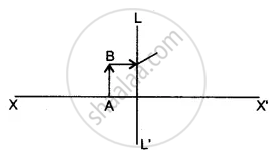
(i) Name the Lens LL’.
(ii) Where is the image of the object AB formed?
(iii) State three characteristics of the image.
The power of the magnifying glass depends on the distance of the magnifying glass from object.
The power of lens depends on the focal length of the lens
Increase in the converging power of eye lens cause ‘hypermetropia'
The same size images are formed by a convex lens when the object is placed at 20 cm or at 10 cm from the lens. The focal length of convex lens is ______ cm.
When monochromatic red light is used instead of blue light in a convex lens, its focal length will ______.
The focal length of a double convex lens is equal to the radius of curvature of either surface. What is the refractive index of its material?
A negative power of a lens indicates a:
For a lens immersed in a medium of refractive index \[n_1\], the power is related to the focal length by:
If the refractive index of the lens material is less than that of the surrounding liquid (\[n_2 < n_1\]), then:
