Advertisements
Advertisements
प्रश्न
Define 1 dioptre of power of a lens.
Advertisements
उत्तर १
The SI unit of power of lens is dioptre which is denoted by the letter D. 1 dioptre is defined as the power of a lens of focal length 1 metre.
उत्तर २
1 dioptre is the power of a lens whose focal length is 1 metre.
संबंधित प्रश्न
State the power of a lens S.I. unit.
A convex lens forms a real and inverted image of a needle at a distance of 50 cm from it. Where is the needle placed in front of the convex lens if the image is equal to the size of the object? Also, find the power of the lens.
Find the power of a concave lens of focal length 2m.
(a) At what distance should the lens be held from the figure in order to view the squares distinctly with the maximum possible magnifying power?
(b) What is the magnification in this case?
(c) Is the magnification equal to the magnifying power in this case? Explain.
You have two lenses A and B of focal lengths +10 cm and –10 cm, respectively. State the nature and power of each lens. Which of the two lenses will form a virtual and magnified image of an object placed 8 cm from the lens? Draw a ray diagram to justify your answer
Ranbir claims to have obtained an image twice the size of the object with a concave lens. Is he correct? Give a reason for your answer.
Kavita from 10th is using spectacles. The power of the lenses in her spectacles is –2.5 dioptre. Answer the following questions:
1) Which lenses are used in her spectacles?
2) State the defect of vision Kavita is suffering from.
3) Find the focal length of the lenses used in her spectacles
Give the usual name for the following:
A point inside a lens through which the light passes undeviated.
Which one of the following materials cannot be used to make a lens?
The focal length of a convex lens is 25 cm. What is its power?
The power of a lens is + 0.2 D. Calculate its focal length.
The power of a lens is, −2 D. What is its focal length?
What is the nature of a lens having a power of + 0.5 D?
A lens has a focal length of, −10 cm. What is the power of the lens and what is its nature?
An object of height 4 cm is placed at a distance of 15 cm in front of a concave lens of power, −10 dioptres. Find the size of the image.
The power of a combination of two lenses X and Y is 5 D. If the focal length of lens X be 15 cm :
(a) calculate the focal length of lens Y.
(b) state the nature of lens Y.
A diverging lens has a focal length of 0.10 m. The power of this lens will be:
A symmetric double convex lens is cut in two equal parts by a plane containing the principal axis. If the power of the original lens was 4 D, the power of a divided lens will be
A lens forms an upright and diminished image of an object, irrespective of its position. What kind of lens is this? Draw an outline ray diagram to show the formation of the image. State the position and one more characteristic of the image.
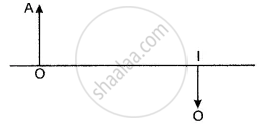
The following diagram shows the object O and the image I formed by a lens. Copy the diagram and on it mark the positions of the lens LL’ and focus (F). Name the lens.
Focal length : metre : : power of lens : _______
The power of the magnifying glass depends on the distance of the magnifying glass from object.
Power of a lens is – 4D, then its focal length is
Assertion and reasoning type
- Assertion: Myopia is due to the increase in the converging power of eye lens.
- Reason: Myopia can be corrected with the help of concave lens.
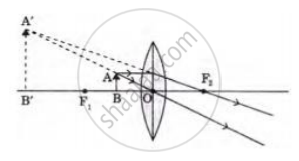
The above lens has a focal length of 10 cm. The object of height 2 mm is placed at a distance of 5 cm from the pole. Find the height of the image.
When monochromatic red light is used instead of blue light in a convex lens, its focal length will ______.
One dioptre is the power of a lens whose focal length is:
A convex lens is a converging lens whose focal length and power are both:
A lens has a power of \[+2\,D\]. Its focal length is:
For a lens with \[f = +12\,cm\], \[R_1 = +10\,cm\] and \[R_2 = -15\,cm\], the lens maker's formula \[\frac{1}{f}=(n-1)\left(\frac{1}{R_1}-\frac{1}{R_2}\right)\] gives the refractive index of the glass as:
