Advertisements
Advertisements
प्रश्न
A lens has a focal length of, −10 cm. What is the power of the lens and what is its nature?
Advertisements
उत्तर
Power of a lens is given by:
Power (P) `=1/f``
`f=-10` cm
∴` p=1/(10xx10^2)=-10 D`
Negative sign indicates it is a diverging lens.
APPEARS IN
संबंधित प्रश्न
Calculate the focal length of a corrective lens having power +2.5 D.
Name the physical quantity whose unit is dioptre.
A diverging lens has focal length of 3 cm. Calculate the power.
The power of a lens is, −2 D. What is its focal length?
The focal length of a lens is +150 mm. What kind of lens is it and what is its power?
Fill in the following blank with suitable word:
For converging lenses, the power is __________ while for diverging lenses, the power is ___________.
A convex lens of power 5 D and a concave lens of power 7.5 D are placed in contact with each other. What is the :
(a) power of this combination of lenses?
(b) focal length of this combination of lenses?
A converging lens has a focal length of 50 cm. The power of this lens is:
A diverging lens has a focal length of 0.10 m. The power of this lens will be:
How does the power of a lens change if its focal length is doubled?
Express the power (with sign) of a concave lens of focal length 20 cm.
A symmetric double convex lens is cut in two equal parts by a plane containing the principal axis. If the power of the original lens was 4 D, the power of a divided lens will be
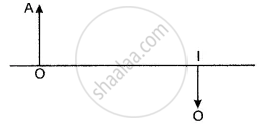
The following diagram shows the object O and the image I formed by a lens. Copy the diagram and on it mark the positions of the lens LL’ and focus (F). Name the lens.
A stick partly immersed in water appears to be bent. Draw a ray diagram to show the bending of the stick when placed in water and viewed obliquely from above.
Increase in the converging power of eye lens cause ‘hypermetropia'
Assertion and reasoning type
- Assertion: Myopia is due to the increase in the converging power of eye lens.
- Reason: Myopia can be corrected with the help of concave lens.
The SI unit of the power of a lens is the:
The power of a lens placed in a medium is given by:
When a lens is placed in a liquid, the total power of the lens is:
For a lens immersed in a medium of refractive index \[n_1\], the power is related to the focal length by:
