Advertisements
Advertisements
प्रश्न
The focal length of a lens is +150 mm. What kind of lens is it and what is its power?
Advertisements
उत्तर
Power of a lens is given by:
Power (P) `=1/f`
`p='1/(150xx10^-3)=6.67 D`
Since the power is positive, the lens is convex in nature.
APPEARS IN
संबंधित प्रश्न
Define the power of a lens.
The lens mentioned in 6(b) above is of focal length 25cm. Calculate the power of the lens.
A student uses a lens of focal length 40 cm and another of –20 cm. Write the nature and power of each lens
Name the physical quantity whose unit is dioptre.
Which type of lens has a positive power?
How is the power of a lens related to its focal length?
What is the nature of a lens having a power of + 0.5 D?
Fill in the following blank with suitable word:
For converging lenses, the power is __________ while for diverging lenses, the power is ___________.
Two lenses A and B have focal lengths of +20 cm and, −10 cm, respectively.
(a) What is the nature of lens A and lens B?
(b) What is the power of lens A and lens B?
(c) What is the power of combination if lenses A and B are held close together?
A combination of lenses for a camera contains two converging lenses of focal lengths 20 cm and 40 cm and a diverging lens of focal length 50 cm. Find the power and focal length of the combination.
State the condition for the following a ray passes undeviated through the lens .
Define power of a lens. Write its units. Deduce the relation `1/f =1/f_1 +1/f_2`for two thin lenses kept in contact coaxially.
Find the radius of curvature of the convex surface of a plano-convex lens, whose focal length is 0.3 m and the refractive index of the material of the lens is 1.5.
A symmetric double convex lens is cut in two equal parts by a plane containing the principal axis. If the power of the original lens was 4 D, the power of a divided lens will be
Consider three converging lenses L1, L2 and L3 having identical geometrical construction. The index of refraction of L1 and L2 are \[\mu_1 \text{ and } \mu_2\] respectively. The upper half of the lens L3 has a refractive index \[\mu_1\] and the lower half has \[\mu_2\] following figure . A point object O is imaged at O1 by the lens L1 and at O2 by the lens L2placed in same position. If L3 is placed at the same place,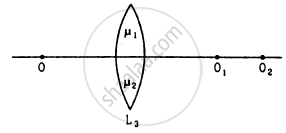
(a) there will be an image at O1
(b) there will be an image at O2.
(c) the only image will form somewhere between O1 and O2
(d) the only image will form away from O2.
A convex lens produces a double size real image when an object is placed at a distance of 18 cm from it. Where should the object be placed to produce a triple size real image?
Consider the situation described in the previous problem. Where should a point source be placed on the principal axis so that the two images form at the same place?
The same size images are formed by a convex lens when the object is placed at 20 cm or at 10 cm from the lens. The focal length of convex lens is ______ cm.
