Advertisements
Advertisements
प्रश्न
A normal eye is not able to see objects closer than 25 cm because
पर्याय
the focal length of the eye is 25 cm
the distance of the retina from the eye-lens is 25 cm
the eye is not able to decrease the distance between the eye-lens and the retina beyond a limit
the eye is not able to decrease the focal length beyond a limit.
Advertisements
उत्तर
the eye is not able to decrease the focal length beyond a limit
The ciliary muscles adjust the focal length to form an image on the retina, but the muscles cannot be strained beyond a limit. Hence, if the object is brought too close to the eye, the focal length cannot be adjusted to form the image on the retina.
APPEARS IN
संबंधित प्रश्न
The lens mentioned in 6(b) above is of focal length 25cm. Calculate the power of the lens.
Kavita from 10th is using spectacles. The power of the lenses in her spectacles is –2.5 dioptre. Answer the following questions:
1) Which lenses are used in her spectacles?
2) State the defect of vision Kavita is suffering from.
3) Find the focal length of the lenses used in her spectacles
The lens A has a focal length of 25 cm whereas another lens B has a focal length of 60 cm. Giving reason state, which lens has more power: A or B.
The focal length of a convex lens is 25 cm. What is its power?
Fill in the following blank with suitable words :
The reciprocal of the focal length in metres gives you the _________ of the lens, which is measured in ___________.
An object of height 4.25 mm is placed at a distance of 10 cm from a convex lens of power +5D. Find (i) the focal length of the lens, and (ii) the size of the image.
The power of a combination of two lenses X and Y is 5 D. If the focal length of lens X be 15 cm :
(a) calculate the focal length of lens Y.
(b) state the nature of lens Y.
Two lenses A and B have focal lengths of +20 cm and, −10 cm, respectively.
(a) What is the nature of lens A and lens B?
(b) What is the power of lens A and lens B?
(c) What is the power of combination if lenses A and B are held close together?
Name the type of lens whose power is positive.
The image of an object formed by a lens is real, inverted and of the same size as the object. If the image is at a distance of 40 cm from the lens, what is the nature and power of the lens ? Draw ray diagram to justify your answer.
A pin of length 2.00 cm is placed perpendicular to the principal axis of a converging lens. An inverted image of size 1.00 cm is formed at a distance of 40.0 cm from the pin. Find the focal length of the lens and its distance from the pin.
Consider the situation described in the previous problem. Where should a point source be placed on the principal axis so that the two images form at the same place?
A diverging lens of focal length 20 cm and a converging lens of focal length 30 cm are placed 15 cm apart with their principal axes coinciding. Where should an object be placed on the principal axis so that its image is formed at infinity?
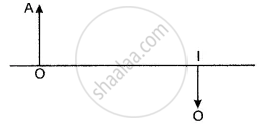
The following diagram shows the object O and the image I formed by a lens. Copy the diagram and on it mark the positions of the lens LL’ and focus (F). Name the lens.
Complete the diagram to show the formation of the image of the object AB.
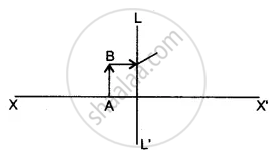
(i) Name the Lens LL’.
(ii) Where is the image of the object AB formed?
(iii) State three characteristics of the image.
A convex lens is of focal length 20 cm. Find its power.
Power of a lens is – 4D, then its focal length is
An object is placed in front of a converging lens. Obtain the conditions under which the magnification produced by the lens is
- negative and
- positive.
For a lens immersed in a medium of refractive index \[n_1\], the power is related to the focal length by:
A convex lens has:
A lens has a power of \[+2\,D\]. Its focal length is:
