Advertisements
Advertisements
प्रश्न
A converging lens has a focal length of 50 cm. The power of this lens is:
पर्याय
+0.2D
−2.0D
+2.0D
−0.2D
Advertisements
उत्तर
+2.0 D
Power `=1/"focal length"=1/0.5=+2D`
APPEARS IN
संबंधित प्रश्न
Define the power of a lens.
Find the focal length of a lens of power −2.0 D. What type of lens is this?
Consider two statements A and B given below:
A: real image is always inverted
B: virtual image is always erect
Out of these two statements:
Give the usual name for the following:
A point inside a lens through which the light passes undeviated.
The lens A has a focal length of 25 cm whereas another lens B has a focal length of 60 cm. Giving reason state, which lens has more power: A or B.
How is the power of a lens related to its focal length?
Two lenses A and B have focal lengths of +20 cm and, −10 cm, respectively.
(a) What is the nature of lens A and lens B?
(b) What is the power of lens A and lens B?
(c) What is the power of combination if lenses A and B are held close together?
The power of a lens is +2.0D. Its focal length should be :
A double convex lens has focal length 25 cm. The radius of curvature of one of the surfaces is double of the other. Find the radii, if the refractive index of the material of the lens is 1.5.
A pin of length 2.00 cm is placed perpendicular to the principal axis of a converging lens. An inverted image of size 1.00 cm is formed at a distance of 40.0 cm from the pin. Find the focal length of the lens and its distance from the pin.
A diverging lens of focal length 20 cm and a converging lens of focal length 30 cm are placed 15 cm apart with their principal axes coinciding. Where should an object be placed on the principal axis so that its image is formed at infinity?
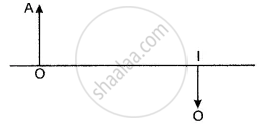
The following diagram shows the object O and the image I formed by a lens. Copy the diagram and on it mark the positions of the lens LL’ and focus (F). Name the lens.
Power of a lens is – 4D, then its focal length is
A convex lens with radii of curvature R1 = R2 is immersed in water. Assuming that the refractive indices of glass and water are 3/2 and 4/3 respectively, its focal length f1 in comparison to that in air, f, is ______.
The power of convex lens of focal length 20 cm is ______.
The power of a lens in dioptres is given by:
When a lens is placed in a liquid, light refracts at:
If the refractive index of the lens material is less than that of the surrounding liquid (\[n_2 < n_1\]), then:
A lens has a power of \[+2\,D\]. Its focal length is:
