Advertisements
Advertisements
प्रश्न
A pin of length 2.00 cm is placed perpendicular to the principal axis of a converging lens. An inverted image of size 1.00 cm is formed at a distance of 40.0 cm from the pin. Find the focal length of the lens and its distance from the pin.
Advertisements
उत्तर
Given,
Height of the object, (h0) = 2 cm,
Height of the image, (h1) = 1 cm
distance between image and object, ( \[-\] u + v) = 40 cm 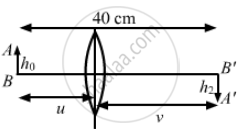
We know that,
Magnification is given by:
\[m = \frac{h_i}{h_0} = \frac{v}{u}, \frac{1}{2} = \frac{v}{- u}\]
u = −2v
Using lens formula,
\[\frac{1}{v} - \frac{1}{u} = \frac{1}{f}\]
\[ \Rightarrow \frac{1}{v} - \frac{1}{- 2v} = \frac{1}{f}\]
\[ \Rightarrow \frac{1}{v} + \frac{1}{2v} = \frac{1}{f}\]
\[ \Rightarrow f = \frac{2v}{3}\]
As per the question,
= −u + v = 40 cm,
= −(−2v) + v = 40 cm,
= 3v = 40 cm
\[v = 13 . 3 = \frac{40}{3} cm, u = \frac{80}{3}\]
∴ f = 8.9 cm
Hence, the required focal length is 8.9 cm and object distance is 26.66 cm.
APPEARS IN
संबंधित प्रश्न
Calculate the focal length of a corrective lens having power +2D.
State the power of a lens S.I. unit.
How unit of power related to focal length of a lens?
The power of a lens is + 0.2 D. Calculate its focal length.
An object of height 4 cm is placed at a distance of 15 cm in front of a concave lens of power, −10 dioptres. Find the size of the image.
A combination of lenses for a camera contains two converging lenses of focal lengths 20 cm and 40 cm and a diverging lens of focal length 50 cm. Find the power and focal length of the combination.
Name the type of lens whose power is positive.
The image of an object formed by a lens is real, inverted and of the same size as the object. If the image is at a distance of 40 cm from the lens, what is the nature and power of the lens ? Draw ray diagram to justify your answer.
A thin converging lens is formed with one surface convex and the other plane. Does the position of image depend on whether the convex surface or the plane surface faces the object?
A screen is placed a distance 40 cm away from an illuminated object. A converging lens is placed between the source and the screen and its is attempted to form the image of the source on the screen. If no position could be found, the focal length of the lens
A diverging lens of focal length 20 cm and a converging lens of focal length 30 cm are placed 15 cm apart with their principal axes coinciding. Where should an object be placed on the principal axis so that its image is formed at infinity?
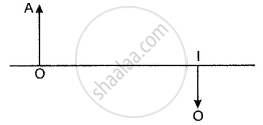
The following diagram shows the object O and the image I formed by a lens. Copy the diagram and on it mark the positions of the lens LL’ and focus (F). Name the lens.
A stick partly immersed in water appears to be bent. Draw a ray diagram to show the bending of the stick when placed in water and viewed obliquely from above.
Complete the diagram to show the formation of the image of the object AB.
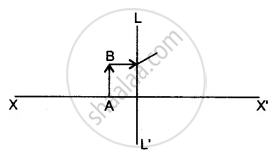
(i) Name the Lens LL’.
(ii) Where is the image of the object AB formed?
(iii) State three characteristics of the image.
If there is a convex lens of focal length 75 cm and a concave lens of focal length 40 cm, then calculate their combined power and combined focal length.
The power of the magnifying glass depends on the distance of the magnifying glass from object.
Power of a lens is – 4D, then its focal length is
Increase in the converging power of eye lens cause ‘hypermetropia'
Match the following:
| Column - I | Column - II | ||
| 1 | Retina | a | Path way of light |
| 2 | Pupil | b | Far point comes closer |
| 3 | Ciliary muscles | c | near point moves away |
| 4 | Myopia | d | Screen of the eye |
| 5 | Hypermetropia | e | Power of accommodation |
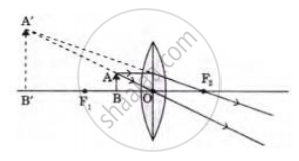
The above lens has a focal length of 10 cm. The object of height 2 mm is placed at a distance of 5 cm from the pole. Find the height of the image.
If the lens material and the surrounding liquid have the same refractive index (\[n_2 = n_1\]), then:
