Advertisements
Advertisements
प्रश्न
Name the type of lens whose power is positive.
The image of an object formed by a lens is real, inverted and of the same size as the object. If the image is at a distance of 40 cm from the lens, what is the nature and power of the lens ? Draw ray diagram to justify your answer.
Advertisements
उत्तर
The power of a convex lens is positive.
It is given that the image of the object formed by the lens is real, inverted and of the same size as the object. Also, we know that only convex lens can form a real and inverted image. Thus, the given lens is a convex lens. In the given case, the object is placed at 2F1 and the image is formed at 2F2.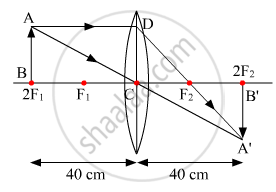
It is clear from the figure that the focal length of the lens (f) is 40 cm.
Now, power (P) is given by
\[P = \frac{1}{f}\]
\[\Rightarrow P = \frac{1}{20 \times {10}^{- 2} m}\]
\[ \Rightarrow P = + 5 D\]
APPEARS IN
संबंधित प्रश्न
Calculate the focal length of a corrective lens having power +2.5 D.
Which type of lens has a positive power?
The focal length of a lens is +150 mm. What kind of lens is it and what is its power?
Fill in the following blank with suitable word:
For converging lenses, the power is __________ while for diverging lenses, the power is ___________.
A symmetric double convex lens in cut in two equal parts by a plane perpendicular to the principal axis. If the power of the original lens was 4 D, the power a cut-lens will be
An object is placed in front of a converging lens. Obtain the conditions under which the magnification produced by the lens is
- negative and
- positive.
A point object is placed at O in front of a glass sphere as shown in figure.

Show the formation of the image by the sphere.
The lens of power + 1·0 D is ______.
The power of a lens in dioptres is given by:
