Advertisements
Advertisements
Question
Name the type of lens whose power is positive.
The image of an object formed by a lens is real, inverted and of the same size as the object. If the image is at a distance of 40 cm from the lens, what is the nature and power of the lens ? Draw ray diagram to justify your answer.
Advertisements
Solution
The power of a convex lens is positive.
It is given that the image of the object formed by the lens is real, inverted and of the same size as the object. Also, we know that only convex lens can form a real and inverted image. Thus, the given lens is a convex lens. In the given case, the object is placed at 2F1 and the image is formed at 2F2.
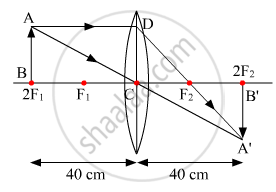
It is clear from the figure that the focal length of the lens (f) is 40 cm.
Now, power (P) is given by
\[P = \frac{1}{f}\]
\[\Rightarrow P = \frac{1}{20 \times {10}^{- 2} m}\]
\[ \Rightarrow P = + 5 D\]
APPEARS IN
RELATED QUESTIONS
Calculate the focal length of a corrective lens having power +2.5 D.
Consider two statements A and B given below:
A: real image is always inverted
B: virtual image is always erect
Out of these two statements:
What is the power of a convex lens lens whose focal length is 80 cm?
Two lenses A and B have focal lengths of +20 cm and, −10 cm, respectively.
(a) What is the nature of lens A and lens B?
(b) What is the power of lens A and lens B?
(c) What is the power of combination if lenses A and B are held close together?
Define the term focal length of a lens.
How is the power of a lens related to its focal length?
On reducing the focal length of a lens, its power ______.
A double convex lens has two surfaces of equal radii R and refractive index \[m = 1 \cdot 5\]
Increase in the converging power of eye lens cause ‘hypermetropia'
The focal length of a double convex lens is equal to the radius of curvature of either surface. What is the refractive index of its material?
