Advertisements
Advertisements
Question
The focal length of a lens is +150 mm. What kind of lens is it and what is its power?
Advertisements
Solution
Power of a lens is given by:
Power (P) `=1/f`
`p='1/(150xx10^-3)=6.67 D`
Since the power is positive, the lens is convex in nature.
APPEARS IN
RELATED QUESTIONS
Calculate the focal length of a corrective lens having power +2D.
What does sign of power (+ve or –ve) indicate?
Define 1 dioptre of power of a lens.
The lens mentioned in 6(b) above is of focal length 25cm. Calculate the power of the lens.
The lens A has a focal length of 25 cm whereas another lens B has a focal length of 60 cm. Giving reason state, which lens has more power: A or B.
The focal length of a convex lens is 25 cm. What is its power?
A convex lens of focal length 25 cm and a concave lens of focal length 10 cm are placed in close contact with one another.
(a) What is the power of this combination?
(b) What is the focal length of this combination?
(c) Is this combination converging or diverging?
State the condition for the following a ray passes undeviated through the lens .
How is the power of a lens related to its focal length?
Name the type of lens whose power is positive.
The image of an object formed by a lens is real, inverted and of the same size as the object. If the image is at a distance of 40 cm from the lens, what is the nature and power of the lens ? Draw ray diagram to justify your answer.
A double convex lens has two surfaces of equal radii R and refractive index \[m = 1 \cdot 5\]
A pin of length 2.00 cm is placed perpendicular to the principal axis of a converging lens. An inverted image of size 1.00 cm is formed at a distance of 40.0 cm from the pin. Find the focal length of the lens and its distance from the pin.
A convex lens produces a double size real image when an object is placed at a distance of 18 cm from it. Where should the object be placed to produce a triple size real image?
A stick partly immersed in water appears to be bent. Draw a ray diagram to show the bending of the stick when placed in water and viewed obliquely from above.
Complete the diagram to show the formation of the image of the object AB.
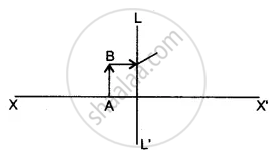
(i) Name the Lens LL’.
(ii) Where is the image of the object AB formed?
(iii) State three characteristics of the image.
If the lens is of focal length 25 cm. Calculate the power of the lens.
Increase in the converging power of eye lens cause ‘hypermetropia'
An object is placed in front of a converging lens. Obtain the conditions under which the magnification produced by the lens is
- negative and
- positive.
The focal length of a double convex lens is equal to the radius of curvature of either surface. What is the refractive index of its material?
If the lens material and the surrounding liquid have the same refractive index (\[n_2 = n_1\]), then:
