Advertisements
Advertisements
Question
An object is kept at a distance of 1m from a lens of power +2D:
- Identify the type of lens.
- Calculate its focal length and distance of the image formed.
Advertisements
Solution
- The given lens is convex because convex lenses have a positive power.
- P = `1/"f"`
+2 = `1/"f"`
f = +0.50 m
Its focal length is +0.50 m.
Using the relation = `1/"f"=1/"v"-1/"u"`
`1/"v"=1/"f"+1/"u"`
= `1/0.5+ (-1)/1`
= `(2+(-1))/1`
v = 1 m
APPEARS IN
RELATED QUESTIONS
Find the focal length of a lens of power −2.0 D. What type of lens is this?
What is the focal length of a convex lens of focal length 30 cm in contact with a concave lens of focal length 20 cm? Is the system a converging or a diverging lens? Ignore thickness of the lenses.
A convex lens of focal length 25 cm and a concave lens of focal length 10 cm are placed in close contact with one another.
(a) What is the power of this combination?
(b) What is the focal length of this combination?
(c) Is this combination converging or diverging?
The power of a lens is + 1.0 D is :
Find the radius of curvature of the convex surface of a plano-convex lens, whose focal length is 0.3 m and the refractive index of the material of the lens is 1.5.
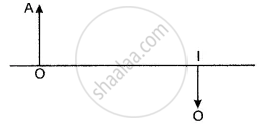
The following diagram shows the object O and the image I formed by a lens. Copy the diagram and on it mark the positions of the lens LL’ and focus (F). Name the lens.
Power of a lens is – 4D, then its focal length is
Increase in the converging power of eye lens cause ‘hypermetropia'
1 D is equivalent to:
The power of a lens placed in a medium is given by:
