Advertisements
Advertisements
Question
A pin of length 2.00 cm is placed perpendicular to the principal axis of a converging lens. An inverted image of size 1.00 cm is formed at a distance of 40.0 cm from the pin. Find the focal length of the lens and its distance from the pin.
Advertisements
Solution
Given,
Height of the object, (h0) = 2 cm,
Height of the image, (h1) = 1 cm
distance between image and object, ( \[-\] u + v) = 40 cm 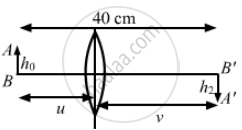
We know that,
Magnification is given by:
\[m = \frac{h_i}{h_0} = \frac{v}{u}, \frac{1}{2} = \frac{v}{- u}\]
u = −2v
Using lens formula,
\[\frac{1}{v} - \frac{1}{u} = \frac{1}{f}\]
\[ \Rightarrow \frac{1}{v} - \frac{1}{- 2v} = \frac{1}{f}\]
\[ \Rightarrow \frac{1}{v} + \frac{1}{2v} = \frac{1}{f}\]
\[ \Rightarrow f = \frac{2v}{3}\]
As per the question,
= −u + v = 40 cm,
= −(−2v) + v = 40 cm,
= 3v = 40 cm
\[v = 13 . 3 = \frac{40}{3} cm, u = \frac{80}{3}\]
∴ f = 8.9 cm
Hence, the required focal length is 8.9 cm and object distance is 26.66 cm.
APPEARS IN
RELATED QUESTIONS
Calculate the focal length of a corrective lens having power +2.5 D.
You have two lenses A and B of focal lengths +10 cm and –10 cm, respectively. State the nature and power of each lens. Which of the two lenses will form a virtual and magnified image of an object placed 8 cm from the lens? Draw a ray diagram to justify your answer
Ranbir claims to have obtained an image twice the size of the object with a concave lens. Is he correct? Give a reason for your answer.
What is the power of a convex lens lens whose focal length is 80 cm?
The power of a lens is, −2 D. What is its focal length?
The focal length of a lens is +150 mm. What kind of lens is it and what is its power?
Two lenses A and B have focal lengths of +20 cm and, −10 cm, respectively.
(a) What is the nature of lens A and lens B?
(b) What is the power of lens A and lens B?
(c) What is the power of combination if lenses A and B are held close together?
What do you understand by the power of a lens?
State the condition for the following a lens has both its focal lengths equal .
How does focal length of a lens change when red light incident on it is replaced by violet light? Give reason for your answer.
Define power of a lens. Write its units. Deduce the relation `1/f =1/f_1 +1/f_2`for two thin lenses kept in contact coaxially.
Find the radius of curvature of the convex surface of a plano-convex lens, whose focal length is 0.3 m and the refractive index of the material of the lens is 1.5.
A thin converging lens is formed with one surface convex and the other plane. Does the position of image depend on whether the convex surface or the plane surface faces the object?
A symmetric double convex lens in cut in two equal parts by a plane perpendicular to the principal axis. If the power of the original lens was 4 D, the power a cut-lens will be
A double convex lens has focal length 25 cm. The radius of curvature of one of the surfaces is double of the other. Find the radii, if the refractive index of the material of the lens is 1.5.
A convex lens produces a double size real image when an object is placed at a distance of 18 cm from it. Where should the object be placed to produce a triple size real image?
Find the power of a convex lens of focal length of + 25 cm.
If focal length of a convex lens is 20 cm at what is the power of the lens?
Power of a lens is – 4D, then its focal length is
An object is kept at a distance of 1m from a lens of power +2D:
- Identify the type of lens.
- Calculate its focal length and distance of the image formed.
