Advertisements
Advertisements
Question
What can you see in a completely dark room? If you switch on an electric bulb in this dark room as a light source, explain how you could now see:
(a) the electric bulb
(b) a piece of white paper
Advertisements
Solution
We cannot see anything in a dark room as there is no light present.
(a) We see the electric bulb because it produces light that reaches our eyes directly.
(b) We see a piece of white paper due to the diffused reflection of light from the surface of the paper.
APPEARS IN
RELATED QUESTIONS
Calculate the focal length of a corrective lens having power +2D.
Find the focal length of a lens of power −2.0 D. What type of lens is this?
A doctor has prescribed a corrective lens of power +1.5 D. Find the focal length of the lens. Is the prescribed lens diverging or converging?
Which one of the following materials cannot be used to make a lens?
Which type of lens has a positive power?
A doctor has prescribed a corrective lens of power, −1.5 D. Find the focal length of the lens. Is the prescribed lens diverging or converging?
A lens has a focal length of, −10 cm. What is the power of the lens and what is its nature?
An object of height 4 cm is placed at a distance of 15 cm in front of a concave lens of power, −10 dioptres. Find the size of the image.
An object of height 4.25 mm is placed at a distance of 10 cm from a convex lens of power +5D. Find (i) the focal length of the lens, and (ii) the size of the image.
The power of a combination of two lenses X and Y is 5 D. If the focal length of lens X be 15 cm :
(a) calculate the focal length of lens Y.
(b) state the nature of lens Y.
What do you understand by the power of a lens?
What is the unit of power of a lens? Define the unit of power of a lens.
A diverging lens has a focal length of 0.10 m. The power of this lens will be:
Define the term focal length of a lens.
On reducing the focal length of a lens, its power ______.
Consider three converging lenses L1, L2 and L3 having identical geometrical construction. The index of refraction of L1 and L2 are \[\mu_1 \text{ and } \mu_2\] respectively. The upper half of the lens L3 has a refractive index \[\mu_1\] and the lower half has \[\mu_2\] following figure . A point object O is imaged at O1 by the lens L1 and at O2 by the lens L2placed in same position. If L3 is placed at the same place,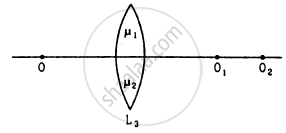
(a) there will be an image at O1
(b) there will be an image at O2.
(c) the only image will form somewhere between O1 and O2
(d) the only image will form away from O2.
The power of convex lens of focal length 20 cm is ______.
A concave lens has:
The power of a lens of focal length \[f = 0.5\,m\] is:
