Advertisements
Advertisements
Question
A double convex lens has two surfaces of equal radii R and refractive index \[m = 1 \cdot 5\]
Options
\[f = R/2\]
- \[f = R\]
\[f = - R\]
\[f = 2R\]
Advertisements
Solution
f = R
As from lens maker formula:
\[\frac{1}{f} = (m - 1)(\frac{1}{R_1} - \frac{1}{R_2})\]
\[ \Rightarrow \frac{1}{f} = (1 . 5 - 1)(\frac{1}{R} - \frac{1}{- R}) (\text{ As given } R_1 = R_2 = R)\]
\[ \frac{1}{f} = (0 . 5)(\frac{1}{R} + \frac{1}{R})\]
\[ \frac{1}{f} = (0 . 5)(\frac{2}{R})\]
\[ f = R\]
APPEARS IN
RELATED QUESTIONS
State the power of a lens S.I. unit.
Which one of the following materials cannot be used to make a lens?
The lens A has a focal length of 25 cm whereas another lens B has a focal length of 60 cm. Giving reason state, which lens has more power: A or B.
The focal length of a lens is +150 mm. What kind of lens is it and what is its power?
Two lenses A and B have focal lengths of +20 cm and, −10 cm, respectively.
(a) What is the nature of lens A and lens B?
(b) What is the power of lens A and lens B?
(c) What is the power of combination if lenses A and B are held close together?
State the condition for the following a ray passes undeviated through the lens .
How does the power of a lens change if its focal length is doubled?
Express the power (with sign) of a concave lens of focal length 20 cm.
Define power of a lens. Write its units. Deduce the relation `1/f =1/f_1 +1/f_2`for two thin lenses kept in contact coaxially.
Mohan obtained a sharp inverted image of a distant tree on the screen placed behind the lens. He then moved the screen and tried to look through the lens in the direction of the object. He would see:
(1) a blurred image on the wall of the laboratory.
(2) an erect image of the tree on the lens.
(3) no image as the screen has been removed
(4) an inverted image of the tree at the focus of the lens.
A thin converging lens is formed with one surface convex and the other plane. Does the position of image depend on whether the convex surface or the plane surface faces the object?
A double convex lens has focal length 25 cm. The radius of curvature of one of the surfaces is double of the other. Find the radii, if the refractive index of the material of the lens is 1.5.
The power of a lens is +2.0 D. Find its focal length and state the kind of lens.
Complete the diagram to show the formation of the image of the object AB.
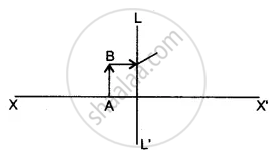
(i) Name the Lens LL’.
(ii) Where is the image of the object AB formed?
(iii) State three characteristics of the image.
If the lens is of focal length 25 cm. Calculate the power of the lens.
If there is a convex lens of focal length 75 cm and a concave lens of focal length 40 cm, then calculate their combined power and combined focal length.
Find the power of a convex lens of focal length of + 25 cm.
The power of convex lens of focal length 20 cm is ______.
1 D is equivalent to:
If the refractive index of the lens material is less than that of the surrounding liquid (\[n_2 < n_1\]), then:
