Advertisements
Advertisements
Question
Mohan obtained a sharp inverted image of a distant tree on the screen placed behind the lens. He then moved the screen and tried to look through the lens in the direction of the object. He would see:
(1) a blurred image on the wall of the laboratory.
(2) an erect image of the tree on the lens.
(3) no image as the screen has been removed
(4) an inverted image of the tree at the focus of the lens.
Advertisements
Solution
(1) a blurred image on the wall of the laboratory.
APPEARS IN
RELATED QUESTIONS
Define the power of a lens.
Ranbir claims to have obtained an image twice the size of the object with a concave lens. Is he correct? Give a reason for your answer.
Consider two statements A and B given below:
A: real image is always inverted
B: virtual image is always erect
Out of these two statements:
A combination of lenses for a camera contains two converging lenses of focal lengths 20 cm and 40 cm and a diverging lens of focal length 50 cm. Find the power and focal length of the combination.
How is the power of a lens related to its focal length?
According to Rayleigh’s scattering law, the amount of scattering of light is inversely proportional to the fourth power of its ______.
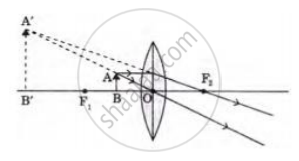
The above lens has a focal length of 10 cm. The object of height 2 mm is placed at a distance of 5 cm from the pole. Find the height of the image.
The lens of power + 1·0 D is ______.
The power of a lens in dioptres is given by:
A lens has a power of \[+2\,D\]. Its focal length is:
