Advertisements
Advertisements
Question
According to Rayleigh’s scattering law, the amount of scattering of light is inversely proportional to the fourth power of its ______.
Advertisements
Solution
According to Rayleigh’s scattering law, the amount of scattering of light is inversely proportional to the fourth power of its wavelength.
APPEARS IN
RELATED QUESTIONS
Find the power of a concave lens of focal length 2m.
Kavita from 10th is using spectacles. The power of the lenses in her spectacles is –2.5 dioptre. Answer the following questions:
1) Which lenses are used in her spectacles?
2) State the defect of vision Kavita is suffering from.
3) Find the focal length of the lenses used in her spectacles
What is the power of a convex lens of focal length 0.5 m?
Define the term focal length of a lens.
State the condition for the following a ray passes undeviated through the lens .
Express the power (with sign) of a concave lens of focal length 20 cm.
Consider three converging lenses L1, L2 and L3 having identical geometrical construction. The index of refraction of L1 and L2 are \[\mu_1 \text{ and } \mu_2\] respectively. The upper half of the lens L3 has a refractive index \[\mu_1\] and the lower half has \[\mu_2\] following figure . A point object O is imaged at O1 by the lens L1 and at O2 by the lens L2placed in same position. If L3 is placed at the same place,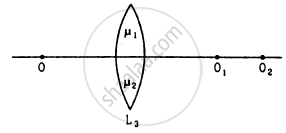
(a) there will be an image at O1
(b) there will be an image at O2.
(c) the only image will form somewhere between O1 and O2
(d) the only image will form away from O2.
The power of lens depends on the focal length of the lens
An object is kept at a distance of 1m from a lens of power +2D:
- Identify the type of lens.
- Calculate its focal length and distance of the image formed.
The lens of power + 1·0 D is ______.
