Advertisements
Advertisements
Question
State the condition for the following a ray passes undeviated through the lens .
Advertisements
Solution
If a ray passes undeviated through the lens it is incident at the optical centre of the lens.
RELATED QUESTIONS
The lens mentioned in 6(b) above is of focal length 25cm. Calculate the power of the lens.
Which of the two has a greater power: a lens of short focal length or a lens of large focal length?
The focal length of a convex lens is 25 cm. What is its power?
On reducing the focal length of a lens, its power ______.
Find the radius of curvature of the convex surface of a plano-convex lens, whose focal length is 0.3 m and the refractive index of the material of the lens is 1.5.
If there is a convex lens of focal length 75 cm and a concave lens of focal length 40 cm, then calculate their combined power and combined focal length.
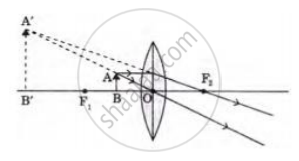
The above lens has a focal length of 10 cm. The object of height 2 mm is placed at a distance of 5 cm from the pole. Find the height of the image.
The SI unit of the power of a lens is the:
One dioptre is the power of a lens whose focal length is:
1 D is equivalent to:
