Advertisements
Advertisements
Question
If there is a convex lens of focal length 75 cm and a concave lens of focal length 40 cm, then calculate their combined power and combined focal length.
Advertisements
Solution
Power of convex lens = `100/("f"("cm"))`
= `100/75` = + 1.33 D.
Power of concave lens = `100/("f"("cm"))`
= `100/40` = − 2.5 D.
Their combined power P = + 1.33 D + (− 2.5 D)
P = − 1.17 D.
Their combined focal length F = `100/"P"=100/(-1.17)`
F = − 85.47 cm.
Negative sign indicates that the nature of their combination is concave.
RELATED QUESTIONS
Define the power of a lens.
Find the power of a concave lens of focal length 2m.
Which of the two has a greater power: a lens of short focal length or a lens of large focal length?
The power of a lens is + 0.2 D. Calculate its focal length.
What is the unit of power of a lens? Define the unit of power of a lens.
How is the power of a lens related to its focal length?
How is the sign (+ or -) of power of a lens related to its divergent or convergent action?
Complete the diagram to show the formation of the image of the object AB.
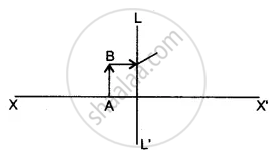
(i) Name the Lens LL’.
(ii) Where is the image of the object AB formed?
(iii) State three characteristics of the image.
In what unit is the power of a lens expressed?
The power of a lens placed in a medium is given by:
