Advertisements
Advertisements
प्रश्न
If there is a convex lens of focal length 75 cm and a concave lens of focal length 40 cm, then calculate their combined power and combined focal length.
Advertisements
उत्तर
Power of convex lens = `100/("f"("cm"))`
= `100/75` = + 1.33 D.
Power of concave lens = `100/("f"("cm"))`
= `100/40` = − 2.5 D.
Their combined power P = + 1.33 D + (− 2.5 D)
P = − 1.17 D.
Their combined focal length F = `100/"P"=100/(-1.17)`
F = − 85.47 cm.
Negative sign indicates that the nature of their combination is concave.
संबंधित प्रश्न
Calculate the focal length of a corrective lens having power +2.5 D.
A convex lens forms a real and inverted image of a needle at a distance of 50 cm from it. Where is the needle placed in front of the convex lens if the image is equal to the size of the object? Also, find the power of the lens.
Find the focal length of a lens of power −2.0 D. What type of lens is this?
The lens mentioned in 6(b) above is of focal length 25cm. Calculate the power of the lens.
A normal eye is not able to see objects closer than 25 cm because
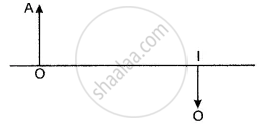
The following diagram shows the object O and the image I formed by a lens. Copy the diagram and on it mark the positions of the lens LL’ and focus (F). Name the lens.
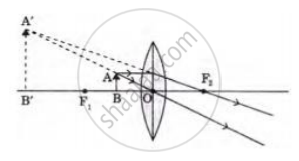
The above lens has a focal length of 10 cm. The object of height 2 mm is placed at a distance of 5 cm from the pole. Find the height of the image.
The deviation of the incident light rays produced by a lens on refraction through it is a measure of its:
When a lens is placed in a liquid, the total power of the lens is:
If the refractive index of the lens material is less than that of the surrounding liquid (\[n_2 < n_1\]), then:
