Advertisements
Advertisements
Questions
Define the power of a lens.
Define the term power of a lens.
Advertisements
Solution 1
Power of a lens is defined as the ability of a lens to bend the rays of light. It is given by the reciprocal of focal length in metre.
Solution 2
The power of a lens is a measure of the deviation produced by it in the path of rays refracted through it.
APPEARS IN
RELATED QUESTIONS
The lens mentioned in 6(b) above is of focal length 25cm. Calculate the power of the lens.
What can you see in a completely dark room? If you switch on an electric bulb in this dark room as a light source, explain how you could now see:
(a) the electric bulb
(b) a piece of white paper
The focal length of a convex lens is 25 cm. What is its power?
A converging lens has focal length of 50 mm. What is the power of the lens?
A convex lens of power 5 D and a concave lens of power 7.5 D are placed in contact with each other. What is the :
(a) power of this combination of lenses?
(b) focal length of this combination of lenses?
Find the radius of curvature of the convex surface of a plano-convex lens, whose focal length is 0.3 m and the refractive index of the material of the lens is 1.5.
A thin converging lens is formed with one surface convex and the other plane. Does the position of image depend on whether the convex surface or the plane surface faces the object?
A symmetric double convex lens is cut in two equal parts by a plane containing the principal axis. If the power of the original lens was 4 D, the power of a divided lens will be
Consider three converging lenses L1, L2 and L3 having identical geometrical construction. The index of refraction of L1 and L2 are \[\mu_1 \text{ and } \mu_2\] respectively. The upper half of the lens L3 has a refractive index \[\mu_1\] and the lower half has \[\mu_2\] following figure . A point object O is imaged at O1 by the lens L1 and at O2 by the lens L2placed in same position. If L3 is placed at the same place,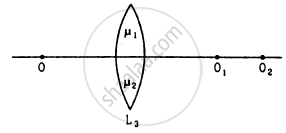
(a) there will be an image at O1
(b) there will be an image at O2.
(c) the only image will form somewhere between O1 and O2
(d) the only image will form away from O2.
Which lens has more power a thick lens or a thin lens?
If there is a convex lens of focal length 75 cm and a concave lens of focal length 40 cm, then calculate their combined power and combined focal length.
A point object is placed at O in front of a glass sphere as shown in figure.

Show the formation of the image by the sphere.
The focal length of a double convex lens is equal to the radius of curvature of either surface. What is the refractive index of its material?
The deviation of the incident light rays produced by a lens on refraction through it is a measure of its:
1 D is equivalent to:
A concave lens is a diverging lens whose focal length and power are both:
A positive power of a lens indicates a:
A negative power of a lens indicates a:
The power of a lens of focal length \[f = 0.5\,m\] is:
