Advertisements
Advertisements
Question
What is the focal length of a convex lens of focal length 30 cm in contact with a concave lens of focal length 20 cm? Is the system a converging or a diverging lens? Ignore thickness of the lenses.
Advertisements
Solution
Focal length of the convex lens, f1 = 30 cm
Focal length of the concave lens, f2 = −20 cm
Focal length of the system of lenses = f
The equivalent focal length of a system of two lenses in contact is given as:
`1/"f" = 1/"f"_1 + 1/"f"_2`
`1/"f" = 1/30 - 1/20`
`1/"f" = (2 - 3)/60`
`1/"f" = -1/60`
∴ f = −60 cm
Hence, the focal length of the combination of lenses is 60 cm. The negative sign indicates that the system of lenses acts as a diverging lens.
RELATED QUESTIONS
What does sign of power (+ve or –ve) indicate?
A convex lens forms a real and inverted image of a needle at a distance of 50 cm from it. Where is the needle placed in front of the convex lens if the image is equal to the size of the object? Also, find the power of the lens.
What can you see in a completely dark room? If you switch on an electric bulb in this dark room as a light source, explain how you could now see:
(a) the electric bulb
(b) a piece of white paper
How is the power of a lens related to its focal length?
The focal length of a convex lens is 25 cm. What is its power?
The optician's prescription for a spectacle lens is marked +0.5 D. What is the:
(a) nature of spectacle lens?
(b) focal length of spectacle lens?
A diverging lens has a focal length of 0.10 m. The power of this lens will be:
Define the term focal length of a lens.
How does the power of a lens change if its focal length is doubled?
The power of a lens is + 1.0 D is :
Find the radius of curvature of the convex surface of a plano-convex lens, whose focal length is 0.3 m and the refractive index of the material of the lens is 1.5.
Consider three converging lenses L1, L2 and L3 having identical geometrical construction. The index of refraction of L1 and L2 are \[\mu_1 \text{ and } \mu_2\] respectively. The upper half of the lens L3 has a refractive index \[\mu_1\] and the lower half has \[\mu_2\] following figure . A point object O is imaged at O1 by the lens L1 and at O2 by the lens L2placed in same position. If L3 is placed at the same place,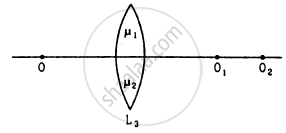
(a) there will be an image at O1
(b) there will be an image at O2.
(c) the only image will form somewhere between O1 and O2
(d) the only image will form away from O2.
A screen is placed a distance 40 cm away from an illuminated object. A converging lens is placed between the source and the screen and its is attempted to form the image of the source on the screen. If no position could be found, the focal length of the lens
A 5.0 diopter lens forms a virtual image which is 4 times the object placed perpendicularly on the principal axis of the lens. Find the distance of the object from the lens.
A point object is placed at O in front of a glass sphere as shown in figure.

Show the formation of the image by the sphere.
1 D is equivalent to:
The power of a lens placed in a medium is given by:
A positive power of a lens indicates a:
When a lens is placed in a liquid, light refracts at:
When a lens is placed in a liquid, the total power of the lens is:
