Advertisements
Advertisements
Question
How does the power of a lens change if its focal length is doubled?
Advertisements
Solution
We know that
`"D"_1 = (100 " cm")/("F.L")` ...(i)
When focal length is doubled
`1"D"_2 = (100 " cm")/("2 F.L") = 50/"FL"` ...(ii)
`"D"_2/"D"_1 = 100/(2 "F.L") xx "F.L."/100 = 1/2`
`therefore "D"_2 = "D"_1/2`
∴ Power is Halved.
If the focal length of a lens is doubled, then its power gets halved.
APPEARS IN
RELATED QUESTIONS
What does sign of power (+ve or –ve) indicate?
A student uses a lens of focal length 40 cm and another of –20 cm. Write the nature and power of each lens
Name the physical quantity whose unit is dioptre.
On reducing the focal length of a lens, its power ______.
The power of a lens is + 1.0 D is :
A lens forms an upright and diminished image of an object, irrespective of its position. What kind of lens is this? Draw an outline ray diagram to show the formation of the image. State the position and one more characteristic of the image.
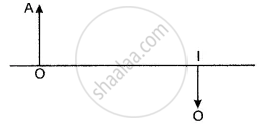
The following diagram shows the object O and the image I formed by a lens. Copy the diagram and on it mark the positions of the lens LL’ and focus (F). Name the lens.
Increase in the converging power of eye lens cause ‘hypermetropia'
The focal length of a concave lens is 20 cm. The focal length of a convex lens is 25 cm. These two are placed in contact with each other. What is the power of the combination? Is it diverging, converging or undeviating in nature?
The power of a lens placed in a medium is given by:
