Advertisements
Advertisements
Question
How is the sign (+ or -) of power of a lens related to its divergent or convergent action?
Advertisements
Solution
The sign of power depends on the direction in which a light ray is deviated by the lens. The power could be positive or negative. If a lens deviates a ray towards its centre (converges), the power is positive and if it deviates the ray away from its centre (diverges), the power is negative.
APPEARS IN
RELATED QUESTIONS
Name the physical quantity whose unit is dioptre.
What is the nature of a lens having a power of + 0.5 D?
What is the nature of a lens whose power is, −4 D?
A converging lens has a focal length of 50 cm. The power of this lens is:
The power of a lens is +2.0D. Its focal length should be :
Define power of a lens. Write its units. Deduce the relation `1/f =1/f_1 +1/f_2`for two thin lenses kept in contact coaxially.
Consider three converging lenses L1, L2 and L3 having identical geometrical construction. The index of refraction of L1 and L2 are \[\mu_1 \text{ and } \mu_2\] respectively. The upper half of the lens L3 has a refractive index \[\mu_1\] and the lower half has \[\mu_2\] following figure . A point object O is imaged at O1 by the lens L1 and at O2 by the lens L2placed in same position. If L3 is placed at the same place,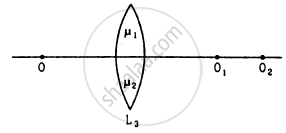
(a) there will be an image at O1
(b) there will be an image at O2.
(c) the only image will form somewhere between O1 and O2
(d) the only image will form away from O2.
Define power of a lens. What is its unit? One student uses a lens of focal length 50 cm and another of –50 cm. What is the nature of the lens and its power used by each of them?
For a lens immersed in a medium of refractive index \[n_1\], the power is related to the focal length by:
The power of a lens of focal length \[f = 0.5\,m\] is:
