Advertisements
Advertisements
Questions
If focal length of a convex lens is 20 cm at what is the power of the lens?
The focal length of a convex lens is 20 cm. What is its power?
If a convex lens focal length is 20 c.m at what is the power of the lens?
Advertisements
Solution
To solve `1/0.2`, you need to remove the decimal from the denominator.
Step 1: Multiply both the numerator (top) and the denominator (bottom) by 10 to shift the decimal point one place to the right.
`P = (1 × 10)/(0.2 × 10)`
Step 2: Simplify the fraction `P = 10/2`
Step 3: Divide 10 by 2. P = 5
So, the final power of the lens is 5 D.
RELATED QUESTIONS
Calculate the focal length of a corrective lens having power +2.5 D.
Define 1 dioptre of power of a lens.
Kavita from 10th is using spectacles. The power of the lenses in her spectacles is –2.5 dioptre. Answer the following questions:
1) Which lenses are used in her spectacles?
2) State the defect of vision Kavita is suffering from.
3) Find the focal length of the lenses used in her spectacles
A student uses a lens of focal length 40 cm and another of –20 cm. Write the nature and power of each lens
What can you see in a completely dark room? If you switch on an electric bulb in this dark room as a light source, explain how you could now see:
(a) the electric bulb
(b) a piece of white paper
Give the usual name for the following:
A point inside a lens through which the light passes undeviated.
Which type of lens has a positive power?
The focal length of a convex lens is 25 cm. What is its power?
What is the power of a convex lens lens whose focal length is 80 cm?
A diverging lens has focal length of 3 cm. Calculate the power.
The power of a lens is + 0.2 D. Calculate its focal length.
A doctor has prescribed a corrective lens of power, −1.5 D. Find the focal length of the lens. Is the prescribed lens diverging or converging?
An object of height 4 cm is placed at a distance of 15 cm in front of a concave lens of power, −10 dioptres. Find the size of the image.
A convex lens of focal length 25 cm and a concave lens of focal length 10 cm are placed in close contact with one another.
(a) What is the power of this combination?
(b) What is the focal length of this combination?
(c) Is this combination converging or diverging?
The power of a combination of two lenses X and Y is 5 D. If the focal length of lens X be 15 cm :
(a) calculate the focal length of lens Y.
(b) state the nature of lens Y.
A converging lens has a focal length of 50 cm. The power of this lens is:
The power of a lens is +2.0D. Its focal length should be :
Define the term focal length of a lens.
State the condition for the following a lens has both its focal lengths equal .
How is the power of a lens related to its focal length?
Mohan obtained a sharp inverted image of a distant tree on the screen placed behind the lens. He then moved the screen and tried to look through the lens in the direction of the object. He would see:
(1) a blurred image on the wall of the laboratory.
(2) an erect image of the tree on the lens.
(3) no image as the screen has been removed
(4) an inverted image of the tree at the focus of the lens.
Consider three converging lenses L1, L2 and L3 having identical geometrical construction. The index of refraction of L1 and L2 are \[\mu_1 \text{ and } \mu_2\] respectively. The upper half of the lens L3 has a refractive index \[\mu_1\] and the lower half has \[\mu_2\] following figure . A point object O is imaged at O1 by the lens L1 and at O2 by the lens L2placed in same position. If L3 is placed at the same place,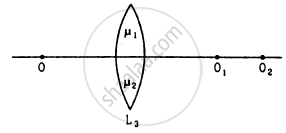
(a) there will be an image at O1
(b) there will be an image at O2.
(c) the only image will form somewhere between O1 and O2
(d) the only image will form away from O2.
A double convex lens has focal length 25 cm. The radius of curvature of one of the surfaces is double of the other. Find the radii, if the refractive index of the material of the lens is 1.5.
A pin of length 2.00 cm is placed perpendicular to the principal axis of a converging lens. An inverted image of size 1.00 cm is formed at a distance of 40.0 cm from the pin. Find the focal length of the lens and its distance from the pin.
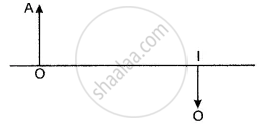
The following diagram shows the object O and the image I formed by a lens. Copy the diagram and on it mark the positions of the lens LL’ and focus (F). Name the lens.
Complete the diagram to show the formation of the image of the object AB.
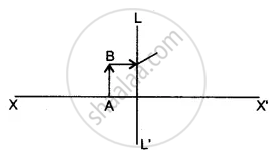
(i) Name the Lens LL’.
(ii) Where is the image of the object AB formed?
(iii) State three characteristics of the image.
If the lens is of focal length 25 cm. Calculate the power of the lens.
If there is a convex lens of focal length 75 cm and a concave lens of focal length 40 cm, then calculate their combined power and combined focal length.
A convex lens with radii of curvature R1 = R2 is immersed in water. Assuming that the refractive indices of glass and water are 3/2 and 4/3 respectively, its focal length f1 in comparison to that in air, f, is ______.
The same size images are formed by a convex lens when the object is placed at 20 cm or at 10 cm from the lens. The focal length of convex lens is ______ cm.
In what unit is the power of a lens expressed?
The deviation of the incident light rays produced by a lens on refraction through it is a measure of its:
A convex lens is a converging lens whose focal length and power are both:
A negative power of a lens indicates a:
A greater numerical value of the power of a lens means:
A convex lens has:
