Advertisements
Advertisements
Question
If the lens is of focal length 25 cm. Calculate the power of the lens.
Advertisements
Solution
Focal length = 25 cm = 0.25 m
P = `1/0.25` = 4D
RELATED QUESTIONS
Calculate the focal length of a corrective lens having power +2.5 D.
A convex lens forms a real and inverted image of a needle at a distance of 50 cm from it. Where is the needle placed in front of the convex lens if the image is equal to the size of the object? Also, find the power of the lens.
What is the unit of power of a lens? Define the unit of power of a lens.
Define the term focal length of a lens.
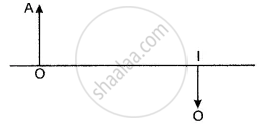
The following diagram shows the object O and the image I formed by a lens. Copy the diagram and on it mark the positions of the lens LL’ and focus (F). Name the lens.
The power of the magnifying glass depends on the distance of the magnifying glass from object.
When monochromatic red light is used instead of blue light in a convex lens, its focal length will ______.
The power of a lens is defined as the:
A greater numerical value of the power of a lens means:
For a lens immersed in a medium of refractive index \[n_1\], the power is related to the focal length by:
