Advertisements
Advertisements
Question
A normal eye is not able to see objects closer than 25 cm because
Options
the focal length of the eye is 25 cm
the distance of the retina from the eye-lens is 25 cm
the eye is not able to decrease the distance between the eye-lens and the retina beyond a limit
the eye is not able to decrease the focal length beyond a limit.
Advertisements
Solution
the eye is not able to decrease the focal length beyond a limit
The ciliary muscles adjust the focal length to form an image on the retina, but the muscles cannot be strained beyond a limit. Hence, if the object is brought too close to the eye, the focal length cannot be adjusted to form the image on the retina.
APPEARS IN
RELATED QUESTIONS
Calculate the focal length of a corrective lens having power +2D.
A doctor has prescribed a corrective lens of power +1.5 D. Find the focal length of the lens. Is the prescribed lens diverging or converging?
The lens mentioned in 6(b) above is of focal length 25cm. Calculate the power of the lens.
Fill in the following blank with suitable words :
The reciprocal of the focal length in metres gives you the _________ of the lens, which is measured in ___________.
Two lenses A and B have focal lengths of +20 cm and, −10 cm, respectively.
(a) What is the nature of lens A and lens B?
(b) What is the power of lens A and lens B?
(c) What is the power of combination if lenses A and B are held close together?
The power of a lens is + 1.0 D is :
How does focal length of a lens change when red light incident on it is replaced by violet light? Give reason for your answer.
A screen is placed a distance 40 cm away from an illuminated object. A converging lens is placed between the source and the screen and its is attempted to form the image of the source on the screen. If no position could be found, the focal length of the lens
A lens forms an upright and diminished image of an object, irrespective of its position. What kind of lens is this? Draw an outline ray diagram to show the formation of the image. State the position and one more characteristic of the image.
A convex lens is of focal length 20 cm. Find its power.
Power of a lens is – 4D, then its focal length is
The power of lens depends on the focal length of the lens
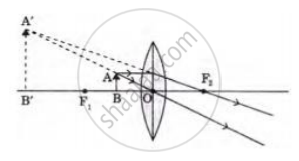
The above lens has a focal length of 10 cm. The object of height 2 mm is placed at a distance of 5 cm from the pole. Find the height of the image.
The focal length of a concave lens is 20 cm. The focal length of a convex lens is 25 cm. These two are placed in contact with each other. What is the power of the combination? Is it diverging, converging or undeviating in nature?
An object is placed in front of a converging lens. Obtain the conditions under which the magnification produced by the lens is
- negative and
- positive.
The SI unit of the power of a lens is the:
For a lens immersed in a medium of refractive index \[n_1\], the power is related to the focal length by:
A lens has a power of \[+2\,D\]. Its focal length is:
For a lens with \[f = +12\,cm\], \[R_1 = +10\,cm\] and \[R_2 = -15\,cm\], the lens maker's formula \[\frac{1}{f}=(n-1)\left(\frac{1}{R_1}-\frac{1}{R_2}\right)\] gives the refractive index of the glass as:
