Advertisements
Advertisements
Question
A convex lens of power 5 D and a concave lens of power 7.5 D are placed in contact with each other. What is the :
(a) power of this combination of lenses?
(b) focal length of this combination of lenses?
Advertisements
Solution
(a) Power of convex lens P1 = + 5 D
Power of concave lens P2 = - 7.5 D
The combined power is the algebraic sum of the individual powers of the lenses.
∴ Power of the combination P = P1 + P2
P = 5 D - 7.5 D = - 2.5 D
Therefore, the power of the combination of the lenses is - 2.5 D.
(b) The power and focal length are related as:
`p=1/f`
`-2.5=1/f`
∴ f=`-1/2.5=-0.4m=-40 cm`
Therefore, the focal length of the combination of the lenses is 40 cm. The negative sign shows that the combination of the two lenses causes it to behave like a concave lens.
APPEARS IN
RELATED QUESTIONS
Calculate the focal length of a corrective lens having power +2.5 D.
What does sign of power (+ve or –ve) indicate?
Find the power of a concave lens of focal length 2m.
Which has more power : a thick convex lens or a thin convex lens, made of the same glass? Give reason for your choice.
What is the power of a convex lens of focal length 0.5 m?
What is the nature of a lens whose power is, −4 D?
The power of a combination of two lenses X and Y is 5 D. If the focal length of lens X be 15 cm :
(a) calculate the focal length of lens Y.
(b) state the nature of lens Y.
Define power of a lens. Write its units. Deduce the relation `1/f =1/f_1 +1/f_2`for two thin lenses kept in contact coaxially.
A normal eye is not able to see objects closer than 25 cm because
A double convex lens has focal length 25 cm. The radius of curvature of one of the surfaces is double of the other. Find the radii, if the refractive index of the material of the lens is 1.5.
A convex lens produces a double size real image when an object is placed at a distance of 18 cm from it. Where should the object be placed to produce a triple size real image?
Consider the situation described in the previous problem. Where should a point source be placed on the principal axis so that the two images form at the same place?
A lens forms an upright and diminished image of an object, irrespective of its position. What kind of lens is this? Draw an outline ray diagram to show the formation of the image. State the position and one more characteristic of the image.
Match the following:
| Column - I | Column - II | ||
| 1 | Retina | a | Path way of light |
| 2 | Pupil | b | Far point comes closer |
| 3 | Ciliary muscles | c | near point moves away |
| 4 | Myopia | d | Screen of the eye |
| 5 | Hypermetropia | e | Power of accommodation |
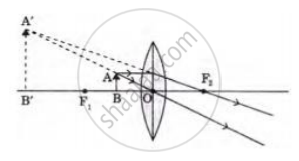
The above lens has a focal length of 10 cm. The object of height 2 mm is placed at a distance of 5 cm from the pole. Find the height of the image.
Define power of a lens. What is its unit? One student uses a lens of focal length 50 cm and another of –50 cm. What is the nature of the lens and its power used by each of them?
A convex lens is a converging lens whose focal length and power are both:
When a lens is placed in a liquid, light refracts at:
