Advertisements
Advertisements
Question
What is the nature of a lens whose power is, −4 D?
Advertisements
Solution
Negative sign indicates it is a diverging lens. Therefore, the lens is concave in nature.
APPEARS IN
RELATED QUESTIONS
Define 1 dioptre of power of a lens.
Find the power of a concave lens of focal length 2m.
You have two lenses A and B of focal lengths +10 cm and –10 cm, respectively. State the nature and power of each lens. Which of the two lenses will form a virtual and magnified image of an object placed 8 cm from the lens? Draw a ray diagram to justify your answer
Ranbir claims to have obtained an image twice the size of the object with a concave lens. Is he correct? Give a reason for your answer.
Which one of the following materials cannot be used to make a lens?
The lens A has a focal length of 25 cm whereas another lens B has a focal length of 60 cm. Giving reason state, which lens has more power: A or B.
Which type of lens has a positive power?
Which has more power : a thick convex lens or a thin convex lens, made of the same glass? Give reason for your choice.
A converging lens has focal length of 50 mm. What is the power of the lens?
What is the unit of power of a lens? Define the unit of power of a lens.
A combination of lenses for a camera contains two converging lenses of focal lengths 20 cm and 40 cm and a diverging lens of focal length 50 cm. Find the power and focal length of the combination.
Complete the diagram to show the formation of the image of the object AB.
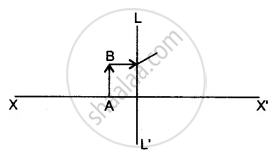
(i) Name the Lens LL’.
(ii) Where is the image of the object AB formed?
(iii) State three characteristics of the image.
If there is a convex lens of focal length 75 cm and a concave lens of focal length 40 cm, then calculate their combined power and combined focal length.
If focal length of a convex lens is 20 cm at what is the power of the lens?
Match the following:
| Column - I | Column - II | ||
| 1 | Retina | a | Path way of light |
| 2 | Pupil | b | Far point comes closer |
| 3 | Ciliary muscles | c | near point moves away |
| 4 | Myopia | d | Screen of the eye |
| 5 | Hypermetropia | e | Power of accommodation |
The focal length of a double convex lens is equal to the radius of curvature of either surface. What is the refractive index of its material?
The lens of power + 1·0 D is ______.
In what unit is the power of a lens expressed?
The deviation of the incident light rays produced by a lens on refraction through it is a measure of its:
