Advertisements
Advertisements
Question
Which one of the following materials cannot be used to make a lens?
Options
Water
Glass
Plastic
Clay
Advertisements
Solution
Clay
Explanation:
since it is opaque and does not let light pass through it.
APPEARS IN
RELATED QUESTIONS
What is meant by a power of a lens? Define its SI unit.
What is the focal length of a convex lens of focal length 30 cm in contact with a concave lens of focal length 20 cm? Is the system a converging or a diverging lens? Ignore thickness of the lenses.
You have two lenses A and B of focal lengths +10 cm and –10 cm, respectively. State the nature and power of each lens. Which of the two lenses will form a virtual and magnified image of an object placed 8 cm from the lens? Draw a ray diagram to justify your answer
Ranbir claims to have obtained an image twice the size of the object with a concave lens. Is he correct? Give a reason for your answer.
Kavita from 10th is using spectacles. The power of the lenses in her spectacles is –2.5 dioptre. Answer the following questions:
1) Which lenses are used in her spectacles?
2) State the defect of vision Kavita is suffering from.
3) Find the focal length of the lenses used in her spectacles
Consider two statements A and B given below:
A: real image is always inverted
B: virtual image is always erect
Out of these two statements:
Which of the two has a greater power: a lens of short focal length or a lens of large focal length?
What is the power of a convex lens of focal length 0.5 m?
A converging lens has focal length of 50 mm. What is the power of the lens?
A lens has a focal length of, −10 cm. What is the power of the lens and what is its nature?
Fill in the following blank with suitable words :
The reciprocal of the focal length in metres gives you the _________ of the lens, which is measured in ___________.
Fill in the following blank with suitable word:
For converging lenses, the power is __________ while for diverging lenses, the power is ___________.
A convex lens of focal length 25 cm and a concave lens of focal length 10 cm are placed in close contact with one another.
(a) What is the power of this combination?
(b) What is the focal length of this combination?
(c) Is this combination converging or diverging?
A converging lens has a focal length of 50 cm. The power of this lens is:
A diverging lens has a focal length of 0.10 m. The power of this lens will be:
Define the term focal length of a lens.
How is the power of a lens related to its focal length?
How does the power of a lens change if its focal length is doubled?
Consider three converging lenses L1, L2 and L3 having identical geometrical construction. The index of refraction of L1 and L2 are \[\mu_1 \text{ and } \mu_2\] respectively. The upper half of the lens L3 has a refractive index \[\mu_1\] and the lower half has \[\mu_2\] following figure . A point object O is imaged at O1 by the lens L1 and at O2 by the lens L2placed in same position. If L3 is placed at the same place,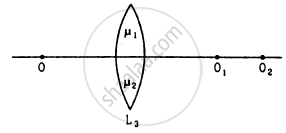
(a) there will be an image at O1
(b) there will be an image at O2.
(c) the only image will form somewhere between O1 and O2
(d) the only image will form away from O2.
Surabhi from std. X uses spectacle. The power of the lenses in her spectacle is 0.5 D.
Answer the following questions from the given information:
- Identify the type of lenses used in her spectacle.
- Identify the defect of vision Surabhi is suffering from.
- Find the focal length of the lenses used in her spectacle.
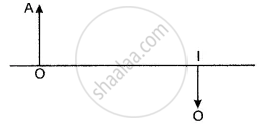
The following diagram shows the object O and the image I formed by a lens. Copy the diagram and on it mark the positions of the lens LL’ and focus (F). Name the lens.
A stick partly immersed in water appears to be bent. Draw a ray diagram to show the bending of the stick when placed in water and viewed obliquely from above.
Complete the diagram to show the formation of the image of the object AB.
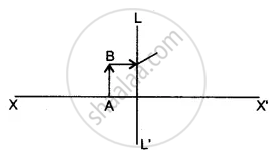
(i) Name the Lens LL’.
(ii) Where is the image of the object AB formed?
(iii) State three characteristics of the image.
Find the power of a convex lens of focal length of + 25 cm.
Increase in the converging power of eye lens cause ‘hypermetropia'
Assertion and reasoning type
- Assertion: Myopia is due to the increase in the converging power of eye lens.
- Reason: Myopia can be corrected with the help of concave lens.
The power of a lens is defined as the:
A positive power of a lens indicates a:
When a lens is placed in a liquid, light refracts at:
The power of a lens of focal length \[f = 0.5\,m\] is:
