Advertisements
Advertisements
प्रश्न
Which one of the following materials cannot be used to make a lens?
विकल्प
Water
Glass
Plastic
Clay
Advertisements
उत्तर
Clay
Explanation:
since it is opaque and does not let light pass through it.
APPEARS IN
संबंधित प्रश्न
What is meant by a power of a lens? Define its SI unit.
State the power of a lens S.I. unit.
Find the power of a concave lens of focal length 2m.
A student uses a lens of focal length 40 cm and another of –20 cm. Write the nature and power of each lens
What can you see in a completely dark room? If you switch on an electric bulb in this dark room as a light source, explain how you could now see:
(a) the electric bulb
(b) a piece of white paper
Give the usual name for the following:
A point inside a lens through which the light passes undeviated.
Which type of lens has a positive power?
A converging lens has focal length of 50 mm. What is the power of the lens?
The power of a lens is, −2 D. What is its focal length?
A doctor has prescribed a corrective lens of power, −1.5 D. Find the focal length of the lens. Is the prescribed lens diverging or converging?
An object of height 4 cm is placed at a distance of 15 cm in front of a concave lens of power, −10 dioptres. Find the size of the image.
What is the unit of power of a lens? Define the unit of power of a lens.
How is the sign (+ or -) of power of a lens related to its divergent or convergent action?
A double convex lens has two surfaces of equal radii R and refractive index \[m = 1 \cdot 5\]
A symmetric double convex lens in cut in two equal parts by a plane perpendicular to the principal axis. If the power of the original lens was 4 D, the power a cut-lens will be
Surabhi from std. X uses spectacle. The power of the lenses in her spectacle is 0.5 D.
Answer the following questions from the given information:
- Identify the type of lenses used in her spectacle.
- Identify the defect of vision Surabhi is suffering from.
- Find the focal length of the lenses used in her spectacle.
Which lens has more power a thick lens or a thin lens?
Complete the diagram to show the formation of the image of the object AB.
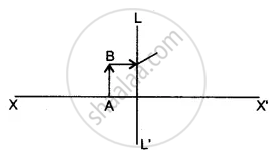
(i) Name the Lens LL’.
(ii) Where is the image of the object AB formed?
(iii) State three characteristics of the image.
Assertion and reasoning type
- Assertion: Myopia is due to the increase in the converging power of eye lens.
- Reason: Myopia can be corrected with the help of concave lens.
Define power of a lens. What is its unit? One student uses a lens of focal length 50 cm and another of –50 cm. What is the nature of the lens and its power used by each of them?
An object is kept at a distance of 1m from a lens of power +2D:
- Identify the type of lens.
- Calculate its focal length and distance of the image formed.
The focal length of a double convex lens is equal to the radius of curvature of either surface. What is the refractive index of its material?
In what unit is the power of a lens expressed?
The deviation of the incident light rays produced by a lens on refraction through it is a measure of its:
The power of a lens in dioptres is given by:
For a lens immersed in a medium of refractive index \[n_1\], the power is related to the focal length by:
