Advertisements
Advertisements
प्रश्न
Find the power of a concave lens of focal length 2m.
Advertisements
उत्तर
The focal length of a concave lens, f = 2m
Power of lens,
P = `1/f`
= `1/(-2)`
= -0.5D
Hence power of the lens = – 0.5 D
APPEARS IN
संबंधित प्रश्न
State the power of a lens S.I. unit.
Find the focal length of a lens of power −2.0 D. What type of lens is this?
Consider two statements A and B given below:
A: real image is always inverted
B: virtual image is always erect
Out of these two statements:
The lens A has a focal length of 25 cm whereas another lens B has a focal length of 60 cm. Giving reason state, which lens has more power: A or B.
Which type of lens has a positive power?
What is the nature of a lens whose power is, −4 D?
The power of a combination of two lenses X and Y is 5 D. If the focal length of lens X be 15 cm :
(a) calculate the focal length of lens Y.
(b) state the nature of lens Y.
Two lenses A and B have focal lengths of +20 cm and, −10 cm, respectively.
(a) What is the nature of lens A and lens B?
(b) What is the power of lens A and lens B?
(c) What is the power of combination if lenses A and B are held close together?
How does the power of a lens change if its focal length is doubled?
A convex lens produces a double size real image when an object is placed at a distance of 18 cm from it. Where should the object be placed to produce a triple size real image?
A lens forms an upright and diminished image of an object, irrespective of its position. What kind of lens is this? Draw an outline ray diagram to show the formation of the image. State the position and one more characteristic of the image.
The power of lens depends on the focal length of the lens
Match the following:
| Column - I | Column - II | ||
| 1 | Retina | a | Path way of light |
| 2 | Pupil | b | Far point comes closer |
| 3 | Ciliary muscles | c | near point moves away |
| 4 | Myopia | d | Screen of the eye |
| 5 | Hypermetropia | e | Power of accommodation |
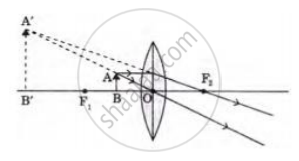
The above lens has a focal length of 10 cm. The object of height 2 mm is placed at a distance of 5 cm from the pole. Find the height of the image.
An object is kept at a distance of 1m from a lens of power +2D:
- Identify the type of lens.
- Calculate its focal length and distance of the image formed.
The power of a lens is defined as the:
The power of a lens in dioptres is given by:
A convex lens is a converging lens whose focal length and power are both:
When a lens is placed in a liquid, the total power of the lens is:
