Advertisements
Advertisements
प्रश्न
Find the focal length of a lens of power −2.0 D. What type of lens is this?
Advertisements
उत्तर
Power of lens,
P = −2.0 D
P = `1/"f"`
∴ f = `1/"P"`
= `1/(-2.0 "D")`
= −0.5 m
A concave lens has a negative focal length. Hence, it is a concave lens.
APPEARS IN
संबंधित प्रश्न
What is meant by a power of a lens? Define its SI unit.
Ranbir claims to have obtained an image twice the size of the object with a concave lens. Is he correct? Give a reason for your answer.
The lens mentioned in 6(b) above is of focal length 25cm. Calculate the power of the lens.
Give the usual name for the following:
A point inside a lens through which the light passes undeviated.
Which has more power : a thick convex lens or a thin convex lens, made of the same glass? Give reason for your choice.
A lens has a focal length of, −10 cm. What is the power of the lens and what is its nature?
An object of height 4 cm is placed at a distance of 15 cm in front of a concave lens of power, −10 dioptres. Find the size of the image.
Two lenses A and B have focal lengths of +20 cm and, −10 cm, respectively.
(a) What is the nature of lens A and lens B?
(b) What is the power of lens A and lens B?
(c) What is the power of combination if lenses A and B are held close together?
What do you understand by the power of a lens?
What is the unit of power of a lens? Define the unit of power of a lens.
State the condition for the following a ray passes undeviated through the lens .
Express the power (with sign) of a concave lens of focal length 20 cm.
A pin of length 2.00 cm is placed perpendicular to the principal axis of a converging lens. An inverted image of size 1.00 cm is formed at a distance of 40.0 cm from the pin. Find the focal length of the lens and its distance from the pin.
Assertion and reasoning type
- Assertion: Myopia is due to the increase in the converging power of eye lens.
- Reason: Myopia can be corrected with the help of concave lens.
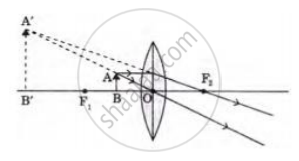
The above lens has a focal length of 10 cm. The object of height 2 mm is placed at a distance of 5 cm from the pole. Find the height of the image.
The deviation of the incident light rays produced by a lens on refraction through it is a measure of its:
A convex lens is a converging lens whose focal length and power are both:
A negative power of a lens indicates a:
A lens has a power of \[+2\,D\]. Its focal length is:
