Advertisements
Advertisements
प्रश्न
A combination of lenses for a camera contains two converging lenses of focal lengths 20 cm and 40 cm and a diverging lens of focal length 50 cm. Find the power and focal length of the combination.
Advertisements
उत्तर
Focal length (f1) of the 1st converging lens = 20 cm = 0.2 m
Focal length (f2) of the 2nd converging lens = 40 cm = 0.4 m
Focal length (f3) of the diverging lens = −50 cm = −0.5 m (negative sign due to sign convention)
Power = `1/"Focal length of lens (in metre)"`
Power (P1) of 1st lens = `1/0.2` = 5 D
Power (P2) of 2nd lens = `1/0.4` = 2.5 D
Power (P3) of diverging lens = `1/0.5` = −2 D
Net power of the combination = P1 + P2 + P3
= 5 + 2.5 + (−2)
= 7.5 − 2
= 5.5 D
Net focal length of the combination = `1/"Net power"`
= `1/5.5`
= 0.1818 m
= 18.18 cm
संबंधित प्रश्न
A convex lens forms a real and inverted image of a needle at a distance of 50 cm from it. Where is the needle placed in front of the convex lens if the image is equal to the size of the object? Also, find the power of the lens.
Find the power of a concave lens of focal length 2m.
Find the focal length of a lens of power −2.0 D. What type of lens is this?
You have two lenses A and B of focal lengths +10 cm and –10 cm, respectively. State the nature and power of each lens. Which of the two lenses will form a virtual and magnified image of an object placed 8 cm from the lens? Draw a ray diagram to justify your answer
The lens A has a focal length of 25 cm whereas another lens B has a focal length of 60 cm. Giving reason state, which lens has more power: A or B.
What is the power of a convex lens of focal length 0.5 m?
The optician's prescription for a spectacle lens is marked +0.5 D. What is the:
(a) nature of spectacle lens?
(b) focal length of spectacle lens?
A doctor has prescribed a corrective lens of power, −1.5 D. Find the focal length of the lens. Is the prescribed lens diverging or converging?
A lens has a focal length of, −10 cm. What is the power of the lens and what is its nature?
The power of a combination of two lenses X and Y is 5 D. If the focal length of lens X be 15 cm :
(a) calculate the focal length of lens Y.
(b) state the nature of lens Y.
What is the unit of power of a lens? Define the unit of power of a lens.
How is the power of a lens related to its focal length?
On reducing the focal length of a lens, its power ______.
Express the power (with sign) of a concave lens of focal length 20 cm.
A screen is placed a distance 40 cm away from an illuminated object. A converging lens is placed between the source and the screen and its is attempted to form the image of the source on the screen. If no position could be found, the focal length of the lens
A convex lens produces a double size real image when an object is placed at a distance of 18 cm from it. Where should the object be placed to produce a triple size real image?
Complete the diagram to show the formation of the image of the object AB.
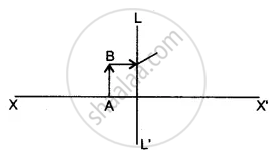
(i) Name the Lens LL’.
(ii) Where is the image of the object AB formed?
(iii) State three characteristics of the image.
If focal length of a convex lens is 20 cm at what is the power of the lens?
The same size images are formed by a convex lens when the object is placed at 20 cm or at 10 cm from the lens. The focal length of convex lens is ______ cm.
The power of convex lens of focal length 20 cm is ______.
In what unit is the power of a lens expressed?
The power of a lens in dioptres is given by:
The power of a lens placed in a medium is given by:
A convex lens is a converging lens whose focal length and power are both:
A negative power of a lens indicates a:
When a lens is placed in a liquid, light refracts at:
A concave lens has:
