Advertisements
Advertisements
प्रश्न
You have two lenses A and B of focal lengths +10 cm and –10 cm, respectively. State the nature and power of each lens. Which of the two lenses will form a virtual and magnified image of an object placed 8 cm from the lens? Draw a ray diagram to justify your answer
Advertisements
उत्तर
Given: Focal length of lens A, fA = +10 cm = +0.1 m
Focal length of lens B, FB = −10 cm = −0.1 m
To calculate the power of lens A:-
The power of lens A, P = 1/FA(in metres)
P = 1/ +0.1
∴ P = +10 dioptre or +10 D
The positive sign indicates that it is a converging or convex lens.
To calculate the power of lens B:-
The power of lens B, P = 1/FB(in meters)
P = 1/ -0.1
∴ P = −10 dioptre or −10 D
The negative sign indicates that it is a diverging or concave lens.
In a convex lens, when the object is placed between the pole and focus, the image formed is always virtual and magnified. On the other hand, a concave lens produces a virtual, erect but diminished image.
Here the object is placed 8 cm from the lens which is at a distance less than the focal length, i.e. less than 10 cm. Thus, the 8 cm position of the object placed in front of the convex lens will produce a virtual and magnified image. The diagram for the same is as shown below:

APPEARS IN
संबंधित प्रश्न
Define the power of a lens.
What is the focal length of a convex lens of focal length 30 cm in contact with a concave lens of focal length 20 cm? Is the system a converging or a diverging lens? Ignore thickness of the lenses.
A converging lens has focal length of 50 mm. What is the power of the lens?
What is the nature of a lens whose power is, −4 D?
The power of a combination of two lenses X and Y is 5 D. If the focal length of lens X be 15 cm :
(a) calculate the focal length of lens Y.
(b) state the nature of lens Y.
Consider three converging lenses L1, L2 and L3 having identical geometrical construction. The index of refraction of L1 and L2 are \[\mu_1 \text{ and } \mu_2\] respectively. The upper half of the lens L3 has a refractive index \[\mu_1\] and the lower half has \[\mu_2\] following figure . A point object O is imaged at O1 by the lens L1 and at O2 by the lens L2placed in same position. If L3 is placed at the same place,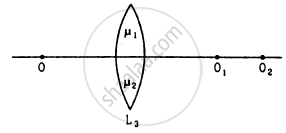
(a) there will be an image at O1
(b) there will be an image at O2.
(c) the only image will form somewhere between O1 and O2
(d) the only image will form away from O2.
A convex lens produces a double size real image when an object is placed at a distance of 18 cm from it. Where should the object be placed to produce a triple size real image?
A convex lens is of focal length 20 cm. Find its power.
Focal length : metre : : power of lens : _______
The deviation of the incident light rays produced by a lens on refraction through it is a measure of its:
