Advertisements
Advertisements
प्रश्न
Consider three converging lenses L1, L2 and L3 having identical geometrical construction. The index of refraction of L1 and L2 are \[\mu_1 \text{ and } \mu_2\] respectively. The upper half of the lens L3 has a refractive index \[\mu_1\] and the lower half has \[\mu_2\] following figure . A point object O is imaged at O1 by the lens L1 and at O2 by the lens L2placed in same position. If L3 is placed at the same place,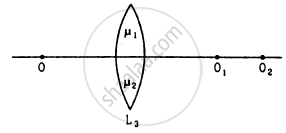
(a) there will be an image at O1
(b) there will be an image at O2.
(c) the only image will form somewhere between O1 and O2
(d) the only image will form away from O2.
Advertisements
उत्तर
(a) there will be an image at O1
(b) there will be an image at O2
The lens L1 converges the light at point O1 and lens L2 converges the light at O2. As the upper half of lens L3 has a refractive index equal to that of L1, it will converge the light at O1 and thus the image will be formed at O1. Also, the lower half of lens L3 has a refractive index equal to that of lens L2, it will converge the light at O2 and thus the image will be formed at O2.
APPEARS IN
संबंधित प्रश्न
State the power of a lens S.I. unit.
Find the focal length of a lens of power −2.0 D. What type of lens is this?
The lens mentioned in 6(b) above is of focal length 25cm. Calculate the power of the lens.
A student uses a lens of focal length 40 cm and another of –20 cm. Write the nature and power of each lens
Name the physical quantity whose unit is dioptre.
Which type of lens has a positive power?
Which has more power : a thick convex lens or a thin convex lens, made of the same glass? Give reason for your choice.
A diverging lens has focal length of 3 cm. Calculate the power.
Fill in the following blank with suitable word:
For converging lenses, the power is __________ while for diverging lenses, the power is ___________.
Express the power (with sign) of a concave lens of focal length 20 cm.
Find the radius of curvature of the convex surface of a plano-convex lens, whose focal length is 0.3 m and the refractive index of the material of the lens is 1.5.
A thin converging lens is formed with one surface convex and the other plane. Does the position of image depend on whether the convex surface or the plane surface faces the object?
A diverging lens of focal length 20 cm and a converging lens of focal length 30 cm are placed 15 cm apart with their principal axes coinciding. Where should an object be placed on the principal axis so that its image is formed at infinity?
The power of a lens is +2.0 D. Find its focal length and state the kind of lens.
Find the power of a convex lens of focal length of + 25 cm.
Assertion and reasoning type
- Assertion: Myopia is due to the increase in the converging power of eye lens.
- Reason: Myopia can be corrected with the help of concave lens.
A convex lens with radii of curvature R1 = R2 is immersed in water. Assuming that the refractive indices of glass and water are 3/2 and 4/3 respectively, its focal length f1 in comparison to that in air, f, is ______.
The SI unit of the power of a lens is the:
1 D is equivalent to:
For a lens with \[f = +12\,cm\], \[R_1 = +10\,cm\] and \[R_2 = -15\,cm\], the lens maker's formula \[\frac{1}{f}=(n-1)\left(\frac{1}{R_1}-\frac{1}{R_2}\right)\] gives the refractive index of the glass as:
