Advertisements
Advertisements
प्रश्न
A thin converging lens is formed with one surface convex and the other plane. Does the position of image depend on whether the convex surface or the plane surface faces the object?
Advertisements
उत्तर
Yes. Using the lens maker formula we can show it. We know that the formula is:
\[\frac{1}{f} = \left( \frac{\mu_2}{\mu_1} - 1 \right)\left( \frac{1}{R_1} - \frac{1}{R_2} \right)\]
Where, f is the focal length of the thin converging lens.
μ2 and μ1 are refractive indexes of lens and air respectively.
R1 and R2 are the radius of curvature of convex and plane surfaces respectively.
Here, R2 = ∞ because of the plane surface.
Case 1
When the convex surface is facing the object, we have:
\[\frac{1}{f} = \left( \frac{\mu_2}{\mu_1} - 1 \right)\left( \frac{1}{R_1} - \frac{1}{\infty} \right)\]
\[\frac{1}{f} = \left( \frac{\mu_2}{\mu_1} - 1 \right)\frac{1}{R_1} . . . (i)\]
Case 2
When the plane surface is facing the object, we have:
\[\frac{1}{f} = \left( \frac{\mu_2}{\mu_1} - 1 \right)\left( \frac{1}{\infty} - \frac{1}{-R_1} \right)\]
\[\frac{1}{f} = \left( \frac{\mu_2}{\mu_1} - 1 \right)\frac{1}{R_1} . . . (ii)\]
For Case 1, the focal length is positive and for the Case 2 the focal length is positive. Thus, the image distance is same in both cases.
APPEARS IN
संबंधित प्रश्न
A convex lens forms a real and inverted image of a needle at a distance of 50 cm from it. Where is the needle placed in front of the convex lens if the image is equal to the size of the object? Also, find the power of the lens.
Consider two statements A and B given below:
A: real image is always inverted
B: virtual image is always erect
Out of these two statements:
The lens A has a focal length of 25 cm whereas another lens B has a focal length of 60 cm. Giving reason state, which lens has more power: A or B.
The focal length of a lens is +150 mm. What kind of lens is it and what is its power?
Fill in the following blank with suitable words :
The reciprocal of the focal length in metres gives you the _________ of the lens, which is measured in ___________.
An object of height 4.25 mm is placed at a distance of 10 cm from a convex lens of power +5D. Find (i) the focal length of the lens, and (ii) the size of the image.
What is the unit of power of a lens? Define the unit of power of a lens.
The power of a lens is +2.0D. Its focal length should be :
How does the power of a lens change if its focal length is doubled?
Consider three converging lenses L1, L2 and L3 having identical geometrical construction. The index of refraction of L1 and L2 are \[\mu_1 \text{ and } \mu_2\] respectively. The upper half of the lens L3 has a refractive index \[\mu_1\] and the lower half has \[\mu_2\] following figure . A point object O is imaged at O1 by the lens L1 and at O2 by the lens L2placed in same position. If L3 is placed at the same place,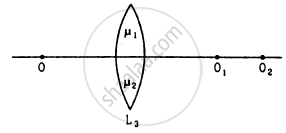
(a) there will be an image at O1
(b) there will be an image at O2.
(c) the only image will form somewhere between O1 and O2
(d) the only image will form away from O2.
A convex lens is of focal length 20 cm. Find its power.
Focal length : metre : : power of lens : _______
Find the power of a convex lens of focal length of + 25 cm.
Power of a lens is – 4D, then its focal length is
The power of a lens in dioptres is given by:
A positive power of a lens indicates a:
A negative power of a lens indicates a:
When a lens is placed in a liquid, light refracts at:
When a lens is placed in a liquid, the total power of the lens is:
