Advertisements
Advertisements
प्रश्न
A 5.0 diopter lens forms a virtual image which is 4 times the object placed perpendicularly on the principal axis of the lens. Find the distance of the object from the lens.
Advertisements
उत्तर
Given,
Power of the lens (P) = \[\frac{1}{\text{ Focal length}}\] = 5.0 D
The height of the image is four times the height of the object.
i.e. \[h_i = 4 h_0 , \frac{h_i}{h_0} = 4\]
We know magnification (m) is also given by \[m = \frac{h_i}{h_0} = \frac{v}{u} \Rightarrow \frac{v}{u} = 4, v = 4u\]
The lens maker formula is given by \[\frac{1}{v} - \frac{1}{u} = \frac{1}{f}\]
Here, v is the image distance and u is the object distance.
Now,
\[\frac{1}{f} = P = 5 \text{ and } f = \frac{1}{5} m = 20 \text{ cm }\]
\[\frac{1}{4u} - \frac{1}{u} = \frac{1}{20}\]
\[ - \frac{3}{4u} = \frac{1}{20}\]
\[ \Rightarrow u = - \frac{60}{4} = - 15 \text{ cm }\]
Hence, the required object distance is 15 cm.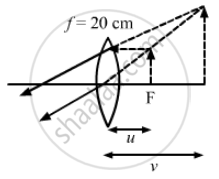
APPEARS IN
संबंधित प्रश्न
(a) At what distance should the lens be held from the figure in order to view the squares distinctly with the maximum possible magnifying power?
(b) What is the magnification in this case?
(c) Is the magnification equal to the magnifying power in this case? Explain.
Which has more power : a thick convex lens or a thin convex lens, made of the same glass? Give reason for your choice.
A converging lens has focal length of 50 mm. What is the power of the lens?
The optician's prescription for a spectacle lens is marked +0.5 D. What is the:
(a) nature of spectacle lens?
(b) focal length of spectacle lens?
The power of a lens is +2.0D. Its focal length should be :
Name the type of lens whose power is positive.
The image of an object formed by a lens is real, inverted and of the same size as the object. If the image is at a distance of 40 cm from the lens, what is the nature and power of the lens ? Draw ray diagram to justify your answer.
Find the radius of curvature of the convex surface of a plano-convex lens, whose focal length is 0.3 m and the refractive index of the material of the lens is 1.5.
A thin converging lens is formed with one surface convex and the other plane. Does the position of image depend on whether the convex surface or the plane surface faces the object?
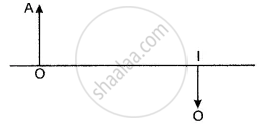
The following diagram shows the object O and the image I formed by a lens. Copy the diagram and on it mark the positions of the lens LL’ and focus (F). Name the lens.
The power of the magnifying glass depends on the distance of the magnifying glass from object.
Power of a lens is – 4D, then its focal length is
The same size images are formed by a convex lens when the object is placed at 20 cm or at 10 cm from the lens. The focal length of convex lens is ______ cm.
An object is kept at a distance of 1m from a lens of power +2D:
- Identify the type of lens.
- Calculate its focal length and distance of the image formed.
The lens of power + 1·0 D is ______.
One dioptre is the power of a lens whose focal length is:
1 D is equivalent to:
The power of a lens in dioptres is given by:
When a lens is placed in a liquid, the total power of the lens is:
