Advertisements
Advertisements
प्रश्न
A converging lens has a focal length of 50 cm. The power of this lens is:
विकल्प
+0.2D
−2.0D
+2.0D
−0.2D
Advertisements
उत्तर
+2.0 D
Power `=1/"focal length"=1/0.5=+2D`
APPEARS IN
संबंधित प्रश्न
Calculate the focal length of a corrective lens having power +2.5 D.
What is meant by a power of a lens? Define its SI unit.
Give the usual name for the following:
A point inside a lens through which the light passes undeviated.
A converging lens has focal length of 50 mm. What is the power of the lens?
An object of height 4.25 mm is placed at a distance of 10 cm from a convex lens of power +5D. Find (i) the focal length of the lens, and (ii) the size of the image.
State the condition for the following a lens has both its focal lengths equal .
A symmetric double convex lens is cut in two equal parts by a plane containing the principal axis. If the power of the original lens was 4 D, the power of a divided lens will be
How is accommodation produced?
Power of a lens is – 4D, then its focal length is
Match the following:
| Column - I | Column - II | ||
| 1 | Retina | a | Path way of light |
| 2 | Pupil | b | Far point comes closer |
| 3 | Ciliary muscles | c | near point moves away |
| 4 | Myopia | d | Screen of the eye |
| 5 | Hypermetropia | e | Power of accommodation |
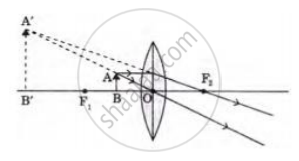
The above lens has a focal length of 10 cm. The object of height 2 mm is placed at a distance of 5 cm from the pole. Find the height of the image.
The power of convex lens of focal length 20 cm is ______.
In what unit is the power of a lens expressed?
The power of a lens placed in a medium is given by:
A concave lens is a diverging lens whose focal length and power are both:
A negative power of a lens indicates a:
When a lens is placed in a liquid, light refracts at:
If the lens material and the surrounding liquid have the same refractive index (\[n_2 = n_1\]), then:
The power of a lens of focal length \[f = 0.5\,m\] is:
