Advertisements
Advertisements
प्रश्न
Calculate the focal length of a corrective lens having power +2D.
Advertisements
उत्तर
Given: Focal length f = +2 D
Power ,p=1/f
∴f=1/p=1/2
∴f=0.5m
The power of the corrective lens is 0.5 m.
APPEARS IN
संबंधित प्रश्न
Calculate the focal length of a corrective lens having power +2.5 D.
A convex lens forms a real and inverted image of a needle at a distance of 50 cm from it. Where is the needle placed in front of the convex lens if the image is equal to the size of the object? Also, find the power of the lens.
A doctor has prescribed a corrective lens of power +1.5 D. Find the focal length of the lens. Is the prescribed lens diverging or converging?
You have two lenses A and B of focal lengths +10 cm and –10 cm, respectively. State the nature and power of each lens. Which of the two lenses will form a virtual and magnified image of an object placed 8 cm from the lens? Draw a ray diagram to justify your answer
A student uses a lens of focal length 40 cm and another of –20 cm. Write the nature and power of each lens
Consider two statements A and B given below:
A: real image is always inverted
B: virtual image is always erect
Out of these two statements:
Name the physical quantity whose unit is dioptre.
Which type of lens has a positive power?
Which of the two has a greater power: a lens of short focal length or a lens of large focal length?
What is the power of a convex lens lens whose focal length is 80 cm?
A diverging lens has focal length of 3 cm. Calculate the power.
The power of a lens is, −2 D. What is its focal length?
The optician's prescription for a spectacle lens is marked +0.5 D. What is the:
(a) nature of spectacle lens?
(b) focal length of spectacle lens?
A doctor has prescribed a corrective lens of power, −1.5 D. Find the focal length of the lens. Is the prescribed lens diverging or converging?
The focal length of a lens is +150 mm. What kind of lens is it and what is its power?
An object of height 4 cm is placed at a distance of 15 cm in front of a concave lens of power, −10 dioptres. Find the size of the image.
An object of height 4.25 mm is placed at a distance of 10 cm from a convex lens of power +5D. Find (i) the focal length of the lens, and (ii) the size of the image.
The power of a combination of two lenses X and Y is 5 D. If the focal length of lens X be 15 cm :
(a) calculate the focal length of lens Y.
(b) state the nature of lens Y.
A combination of lenses for a camera contains two converging lenses of focal lengths 20 cm and 40 cm and a diverging lens of focal length 50 cm. Find the power and focal length of the combination.
A diverging lens has a focal length of 0.10 m. The power of this lens will be:
How does the power of a lens change if its focal length is doubled?
How does focal length of a lens change when red light incident on it is replaced by violet light? Give reason for your answer.
A double convex lens has two surfaces of equal radii R and refractive index \[m = 1 \cdot 5\]
A double convex lens has focal length 25 cm. The radius of curvature of one of the surfaces is double of the other. Find the radii, if the refractive index of the material of the lens is 1.5.
Consider the situation described in the previous problem. Where should a point source be placed on the principal axis so that the two images form at the same place?
The following diagram shows the object O and the image I formed by a lens. Copy the diagram and on it mark the positions of the lens LL’ and focus (F). Name the lens.
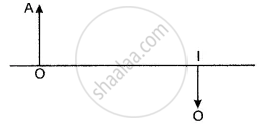
If the lens is of focal length 25 cm. Calculate the power of the lens.
If there is a convex lens of focal length 75 cm and a concave lens of focal length 40 cm, then calculate their combined power and combined focal length.
Assertion and reasoning type
- Assertion: Myopia is due to the increase in the converging power of eye lens.
- Reason: Myopia can be corrected with the help of concave lens.
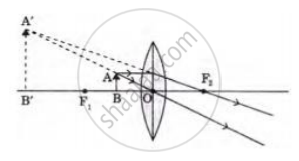
The above lens has a focal length of 10 cm. The object of height 2 mm is placed at a distance of 5 cm from the pole. Find the height of the image.
Define power of a lens. What is its unit? One student uses a lens of focal length 50 cm and another of –50 cm. What is the nature of the lens and its power used by each of them?
When monochromatic red light is used instead of blue light in a convex lens, its focal length will ______.
When a lens is placed in a liquid, the total power of the lens is:
If the lens material and the surrounding liquid have the same refractive index (\[n_2 = n_1\]), then:
A convex lens has:
