Advertisements
Advertisements
प्रश्न
Calculate the focal length of a corrective lens having power +2.5 D.
Advertisements
उत्तर
Solution: Data: Convex lens, P = +2.5 D, f = ?
P = 1/f
∴ 2.5 D = 1/f
∴ f = 1/2.5D = 0.4m = 40cm
The focal length of the lens is 40 cm.
APPEARS IN
संबंधित प्रश्न
What is meant by a power of a lens? Define its SI unit.
You have two lenses A and B of focal lengths +10 cm and –10 cm, respectively. State the nature and power of each lens. Which of the two lenses will form a virtual and magnified image of an object placed 8 cm from the lens? Draw a ray diagram to justify your answer
Give the usual name for the following:
A point inside a lens through which the light passes undeviated.
Which has more power : a thick convex lens or a thin convex lens, made of the same glass? Give reason for your choice.
The focal length of a convex lens is 25 cm. What is its power?
A converging lens has focal length of 50 mm. What is the power of the lens?
What is the nature of a lens having a power of + 0.5 D?
What is the nature of a lens whose power is, −4 D?
The optician's prescription for a spectacle lens is marked +0.5 D. What is the:
(a) nature of spectacle lens?
(b) focal length of spectacle lens?
The focal length of a lens is +150 mm. What kind of lens is it and what is its power?
Fill in the following blank with suitable word:
For converging lenses, the power is __________ while for diverging lenses, the power is ___________.
An object of height 4 cm is placed at a distance of 15 cm in front of a concave lens of power, −10 dioptres. Find the size of the image.
An object of height 4.25 mm is placed at a distance of 10 cm from a convex lens of power +5D. Find (i) the focal length of the lens, and (ii) the size of the image.
A convex lens of focal length 25 cm and a concave lens of focal length 10 cm are placed in close contact with one another.
(a) What is the power of this combination?
(b) What is the focal length of this combination?
(c) Is this combination converging or diverging?
What do you understand by the power of a lens?
A diverging lens has a focal length of 0.10 m. The power of this lens will be:
Define the term focal length of a lens.
State the condition for the following a ray passes undeviated through the lens .
The power of a lens is + 1.0 D is :
A double convex lens has two surfaces of equal radii R and refractive index \[m = 1 \cdot 5\]
A screen is placed a distance 40 cm away from an illuminated object. A converging lens is placed between the source and the screen and its is attempted to form the image of the source on the screen. If no position could be found, the focal length of the lens
A convex lens produces a double size real image when an object is placed at a distance of 18 cm from it. Where should the object be placed to produce a triple size real image?
Surabhi from std. X uses spectacle. The power of the lenses in her spectacle is 0.5 D.
Answer the following questions from the given information:
- Identify the type of lenses used in her spectacle.
- Identify the defect of vision Surabhi is suffering from.
- Find the focal length of the lenses used in her spectacle.
A stick partly immersed in water appears to be bent. Draw a ray diagram to show the bending of the stick when placed in water and viewed obliquely from above.
Complete the diagram to show the formation of the image of the object AB.
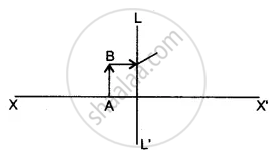
(i) Name the Lens LL’.
(ii) Where is the image of the object AB formed?
(iii) State three characteristics of the image.
According to Rayleigh’s scattering law, the amount of scattering of light is inversely proportional to the fourth power of its ______.
The power of lens depends on the focal length of the lens
The focal length of a concave lens is 20 cm. The focal length of a convex lens is 25 cm. These two are placed in contact with each other. What is the power of the combination? Is it diverging, converging or undeviating in nature?
An object is placed in front of a converging lens. Obtain the conditions under which the magnification produced by the lens is
- negative and
- positive.
The same size images are formed by a convex lens when the object is placed at 20 cm or at 10 cm from the lens. The focal length of convex lens is ______ cm.
In what unit is the power of a lens expressed?
The deviation of the incident light rays produced by a lens on refraction through it is a measure of its:
A concave lens is a diverging lens whose focal length and power are both:
A positive power of a lens indicates a:
If the lens material and the surrounding liquid have the same refractive index (\[n_2 = n_1\]), then:
A convex lens has:
For a lens with \[f = +12\,cm\], \[R_1 = +10\,cm\] and \[R_2 = -15\,cm\], the lens maker's formula \[\frac{1}{f}=(n-1)\left(\frac{1}{R_1}-\frac{1}{R_2}\right)\] gives the refractive index of the glass as:
