Advertisements
Advertisements
प्रश्न
What do you understand by the power of a lens?
Advertisements
उत्तर
The power of a lens is a measure of the degree of convergence or divergence of light rays falling on it. The power of a lens is defined as the reciprocal of its focal length in metres.
i.e., Power of lens = `1/"focal length of lens (in metres)"`
or, P = `1/f`
APPEARS IN
संबंधित प्रश्न
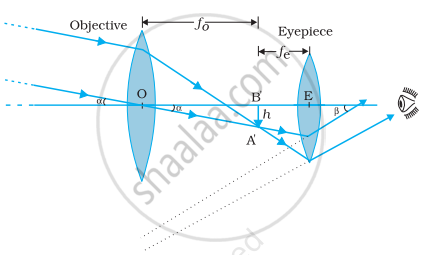
(a) At what distance should the lens be held from the figure in order to view the squares distinctly with the maximum possible magnifying power?
(b) What is the magnification in this case?
(c) Is the magnification equal to the magnifying power in this case? Explain.
The lens mentioned in 6(b) above is of focal length 25cm. Calculate the power of the lens.
What is the power of a convex lens of focal length 0.5 m?
A doctor has prescribed a corrective lens of power, −1.5 D. Find the focal length of the lens. Is the prescribed lens diverging or converging?
State the condition for the following a lens has both its focal lengths equal .
Find the radius of curvature of the convex surface of a plano-convex lens, whose focal length is 0.3 m and the refractive index of the material of the lens is 1.5.
A normal eye is not able to see objects closer than 25 cm because
Consider three converging lenses L1, L2 and L3 having identical geometrical construction. The index of refraction of L1 and L2 are \[\mu_1 \text{ and } \mu_2\] respectively. The upper half of the lens L3 has a refractive index \[\mu_1\] and the lower half has \[\mu_2\] following figure . A point object O is imaged at O1 by the lens L1 and at O2 by the lens L2placed in same position. If L3 is placed at the same place,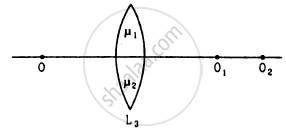
(a) there will be an image at O1
(b) there will be an image at O2.
(c) the only image will form somewhere between O1 and O2
(d) the only image will form away from O2.
Surabhi from std. X uses spectacle. The power of the lenses in her spectacle is 0.5 D.
Answer the following questions from the given information:
- Identify the type of lenses used in her spectacle.
- Identify the defect of vision Surabhi is suffering from.
- Find the focal length of the lenses used in her spectacle.
A stick partly immersed in water appears to be bent. Draw a ray diagram to show the bending of the stick when placed in water and viewed obliquely from above.
Find the power of a convex lens of focal length of + 25 cm.
Define power of a lens. What is its unit? One student uses a lens of focal length 50 cm and another of –50 cm. What is the nature of the lens and its power used by each of them?
The focal length of a concave lens is 20 cm. The focal length of a convex lens is 25 cm. These two are placed in contact with each other. What is the power of the combination? Is it diverging, converging or undeviating in nature?
When monochromatic red light is used instead of blue light in a convex lens, its focal length will ______.
The power of convex lens of focal length 20 cm is ______.
An object is kept at a distance of 1m from a lens of power +2D:
- Identify the type of lens.
- Calculate its focal length and distance of the image formed.
The power of a lens placed in a medium is given by:
When a lens is placed in a liquid, the total power of the lens is:
A concave lens has:
The power of a lens of focal length \[f = 0.5\,m\] is:
