Advertisements
Advertisements
प्रश्न
Two lenses A and B have focal lengths of +20 cm and, −10 cm, respectively.
(a) What is the nature of lens A and lens B?
(b) What is the power of lens A and lens B?
(c) What is the power of combination if lenses A and B are held close together?
Advertisements
उत्तर
(a) The focal length of lens A is +20 cm. The positive sign indicates that lens A is convex, i.e., a converging lens.
The focal length of lens B is -10 cm. The negative sign indicates that lens B is concave, i.e., a diverging lens.
(b) Focal length of lens A, fA = +20 cm = +0.20 m
∴ Power of lens `A, P_A=1/(f_A)=1/0.20=5D`
Focal length of lens B, fB = -10 cm = -0.10 m
∴ Power of lens B, `P_B=1/f_b=1/-0.10=-10D`
(c) When lenses are combined, the power of the combination is the algebraic sum of the powers of the individual lenses.
∴ Power of combination of lens A and B,p=P_A=P_B
` P=5D-10D=-5D.`
APPEARS IN
संबंधित प्रश्न
Find the power of a concave lens of focal length 2m.
(a) At what distance should the lens be held from the figure in order to view the squares distinctly with the maximum possible magnifying power?
(b) What is the magnification in this case?
(c) Is the magnification equal to the magnifying power in this case? Explain.
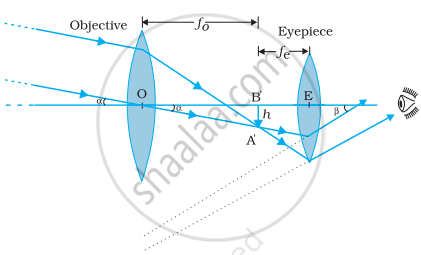
The lens A has a focal length of 25 cm whereas another lens B has a focal length of 60 cm. Giving reason state, which lens has more power: A or B.
Which of the two has a greater power: a lens of short focal length or a lens of large focal length?
What is the power of a convex lens lens whose focal length is 80 cm?
An object of height 4 cm is placed at a distance of 15 cm in front of a concave lens of power, −10 dioptres. Find the size of the image.
The power of a combination of two lenses X and Y is 5 D. If the focal length of lens X be 15 cm :
(a) calculate the focal length of lens Y.
(b) state the nature of lens Y.
The power of a lens is +2.0D. Its focal length should be :
How does the power of a lens change if its focal length is doubled?
Name the type of lens whose power is positive.
The image of an object formed by a lens is real, inverted and of the same size as the object. If the image is at a distance of 40 cm from the lens, what is the nature and power of the lens ? Draw ray diagram to justify your answer.
A pin of length 2.00 cm is placed perpendicular to the principal axis of a converging lens. An inverted image of size 1.00 cm is formed at a distance of 40.0 cm from the pin. Find the focal length of the lens and its distance from the pin.
A diverging lens of focal length 20 cm and a converging lens of focal length 30 cm are placed 15 cm apart with their principal axes coinciding. Where should an object be placed on the principal axis so that its image is formed at infinity?
The power of a lens is +2.0 D. Find its focal length and state the kind of lens.
A stick partly immersed in water appears to be bent. Draw a ray diagram to show the bending of the stick when placed in water and viewed obliquely from above.
If focal length of a convex lens is 20 cm at what is the power of the lens?
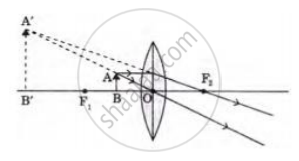
The above lens has a focal length of 10 cm. The object of height 2 mm is placed at a distance of 5 cm from the pole. Find the height of the image.
The focal length of a concave lens is 20 cm. The focal length of a convex lens is 25 cm. These two are placed in contact with each other. What is the power of the combination? Is it diverging, converging or undeviating in nature?
The SI unit of the power of a lens is the:
