Advertisements
Advertisements
प्रश्न
(a) At what distance should the lens be held from the figure in order to view the squares distinctly with the maximum possible magnifying power?
(b) What is the magnification in this case?
(c) Is the magnification equal to the magnifying power in this case? Explain.
Advertisements
उत्तर
(a) The maximum possible magnification is obtained when the image is formed at the near point (d = 25 cm).
Image distance, v = −d = −25 cm
Focal length, f = 10 cm
Object distance = u
According to the lens formula, we have:
`1/"f" = 1/"v" - 1/"u"`
`1/"u" = 1/"v" - 1/"f"`
= `1/(-25) - 1/10`
= `(-2-5)/50`
= `- 7/50`
∴ u = `50/7` = −7.14 cm
Hence, to view the squares distinctly, the lens should be kept 7.14 cm away from them.
(b) Magnification = `|"v"/"u"| = 25/(50/7)` = 3.5
(c) Magnifying power = `"d"/"u" = 25/(50/7)` = 3.5
Since the image is formed at the near point (25 cm), the magnifying power is equal to the magnitude of magnification.
APPEARS IN
संबंधित प्रश्न
Define the power of a lens.
Give the usual name for the following:
A point inside a lens through which the light passes undeviated.
A converging lens has focal length of 50 mm. What is the power of the lens?
A lens has a focal length of, −10 cm. What is the power of the lens and what is its nature?
The focal length of a lens is +150 mm. What kind of lens is it and what is its power?
A convex lens of focal length 25 cm and a concave lens of focal length 10 cm are placed in close contact with one another.
(a) What is the power of this combination?
(b) What is the focal length of this combination?
(c) Is this combination converging or diverging?
State the condition for the following a lens has both its focal lengths equal .
A symmetric double convex lens in cut in two equal parts by a plane perpendicular to the principal axis. If the power of the original lens was 4 D, the power a cut-lens will be
A lens forms an upright and diminished image of an object, irrespective of its position. What kind of lens is this? Draw an outline ray diagram to show the formation of the image. State the position and one more characteristic of the image.
A stick partly immersed in water appears to be bent. Draw a ray diagram to show the bending of the stick when placed in water and viewed obliquely from above.
Complete the diagram to show the formation of the image of the object AB.
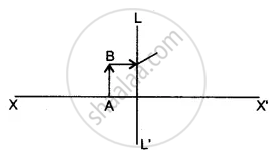
(i) Name the Lens LL’.
(ii) Where is the image of the object AB formed?
(iii) State three characteristics of the image.
An object is placed in front of a converging lens. Obtain the conditions under which the magnification produced by the lens is
- negative and
- positive.
A point object is placed at O in front of a glass sphere as shown in figure.

Show the formation of the image by the sphere.
When monochromatic red light is used instead of blue light in a convex lens, its focal length will ______.
In what unit is the power of a lens expressed?
One dioptre is the power of a lens whose focal length is:
A convex lens is a converging lens whose focal length and power are both:
When a lens is placed in a liquid, light refracts at:
If the refractive index of the lens material is less than that of the surrounding liquid (\[n_2 < n_1\]), then:
