Advertisements
Advertisements
प्रश्न
Complete the diagram to show the formation of the image of the object AB.
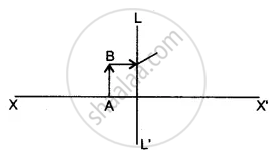
(i) Name the Lens LL’.
(ii) Where is the image of the object AB formed?
(iii) State three characteristics of the image.
Advertisements
उत्तर
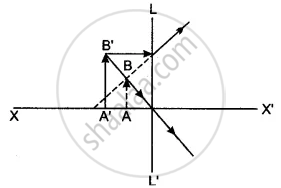
(i) The lens is a diverging (or concave) lens.
(ii) The image of the objects is A’B’ which is formed between the optical centre and focus of the lens, in front of it.
(iii) The image is (a) virtual, (b) upright, and (c) diminished.
संबंधित प्रश्न
The lens A has a focal length of 25 cm whereas another lens B has a focal length of 60 cm. Giving reason state, which lens has more power: A or B.
How is the power of a lens related to its focal length?
A converging lens has focal length of 50 mm. What is the power of the lens?
An object of height 4 cm is placed at a distance of 15 cm in front of a concave lens of power, −10 dioptres. Find the size of the image.
An object of height 4.25 mm is placed at a distance of 10 cm from a convex lens of power +5D. Find (i) the focal length of the lens, and (ii) the size of the image.
Define the term focal length of a lens.
State the condition for the following a lens has both its focal lengths equal .
How is the sign (+ or -) of power of a lens related to its divergent or convergent action?
An object is placed in front of a converging lens. Obtain the conditions under which the magnification produced by the lens is
- negative and
- positive.
The focal length of a double convex lens is equal to the radius of curvature of either surface. What is the refractive index of its material?
