Advertisements
Advertisements
Question
Complete the diagram to show the formation of the image of the object AB.
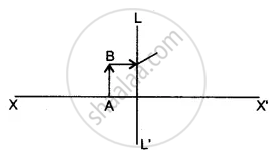
(i) Name the Lens LL’.
(ii) Where is the image of the object AB formed?
(iii) State three characteristics of the image.
Advertisements
Solution
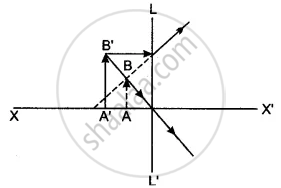
(i) The lens is a diverging (or concave) lens.
(ii) The image of the objects is A’B’ which is formed between the optical centre and focus of the lens, in front of it.
(iii) The image is (a) virtual, (b) upright, and (c) diminished.
RELATED QUESTIONS
What is the focal length of a convex lens of focal length 30 cm in contact with a concave lens of focal length 20 cm? Is the system a converging or a diverging lens? Ignore thickness of the lenses.
Name the physical quantity whose unit is dioptre.
A diverging lens has focal length of 3 cm. Calculate the power.
State the condition for the following a ray passes undeviated through the lens .
How is the sign (+ or -) of power of a lens related to its divergent or convergent action?
A symmetric double convex lens in cut in two equal parts by a plane perpendicular to the principal axis. If the power of the original lens was 4 D, the power a cut-lens will be
The power of a lens is +2.0 D. Find its focal length and state the kind of lens.
Focal length : metre : : power of lens : _______
Match the following:
| Column - I | Column - II | ||
| 1 | Retina | a | Path way of light |
| 2 | Pupil | b | Far point comes closer |
| 3 | Ciliary muscles | c | near point moves away |
| 4 | Myopia | d | Screen of the eye |
| 5 | Hypermetropia | e | Power of accommodation |
The focal length of a concave lens is 20 cm. The focal length of a convex lens is 25 cm. These two are placed in contact with each other. What is the power of the combination? Is it diverging, converging or undeviating in nature?
